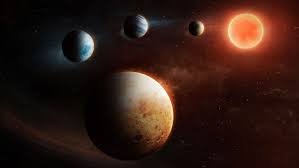
A Solar System That Defies Expectations
A newly discovered exoplanetary system, located approximately 116 light-years from Earth, is forcing scientists to rethink long-held beliefs about how planets are born. Observations from NASA and the European Space Agency (ESA) telescopes have revealed a peculiar arrangement around the red dwarf star LHS 1903, challenging the conventional model of planet formation.
An ‘Inside-Out’ Planetary System
The LHS 1903 system hosts four planets, arranged in an unexpected sequence. The innermost planet is rocky, followed by two gas giants, and then, surprisingly, another rocky planet at the outermost orbit. This configuration is a stark contrast to our own solar system and most others observed, where rocky planets reside closer to the star and gas giants are found farther out.
Traditionally, astronomers believed this pattern arose from the temperature gradient within the protoplanetary disk surrounding a young star. Closer to the star, intense heat vaporizes volatile compounds, leaving only heat-resistant materials like rock and metal to coalesce. Further out, beyond the “snow line,” temperatures are cold enough for ices to form, allowing planetary cores to grow rapidly and eventually attract vast amounts of gas.
Challenging the Standard Model
“The paradigm of planet formation is that we have rocky inner planets very close to the stars, like in our solar system,” explains Thomas Wilson, assistant professor at the University of Warwick and lead author of a study published in Science. “This is the first time we’ve found a rocky planet so far from its star, after these gas-rich planets.”
The outermost rocky planet, LHS 1903 e, is a “super-Earth” – larger than our planet but with similar density and composition. Its existence raises a critical question: how did it form in a location where gas and ice were scarce?
A New Formation Mechanism?
Researchers hypothesize that the planets in the LHS 1903 system formed in a different order than those in our solar system, starting with the innermost planet and moving outward. This “gas-depleted” formation mechanism suggests that LHS 1903 e formed millions of years after the inner planets, when the protoplanetary disk had already lost much of its gas and dust.
“This formation mechanism, where you start with the inner one and then you move away from the host star, means the outermost planet formed millions of years after the innermost one,” Wilson said. “And because it formed later, there was actually not that much gas and dust in the disk left to build this planet from.”
Discovery and Future Research
The system was initially identified by NASA’s Transiting Exoplanet Survey Satellite (TESS) and subsequently analyzed by ESA’s CHaracterising ExOPlanet Satellite (Cheops). Further data from ground-based telescopes contributed to this international collaborative effort. Scientists ruled out scenarios involving planetary collisions or atmospheric stripping as explanations for the unusual arrangement.
Sara Seager, a professor at MIT, notes that the finding provides “some of the first evidence for flipping the script on how planets form around the most common stars in our galaxy.” However, she cautions that the interpretation is complex and further research is needed.
Heather Knutson, a professor at Caltech, highlights the potential for future observations with the James Webb Space Telescope to reveal more about the atmospheric properties of LHS 1903 e and other planets in the system. This solar system offers a unique opportunity to study planet formation around a star different from our own.
Learn more about exoplanet research at NASA Exoplanet Exploration.