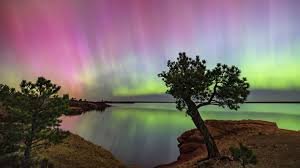
Aurora Forecast: Prepare for a Stunning Display!
Aurora chasers, get ready! The skies are poised to deliver a spectacular show over the coming days. Several incoming coronal mass ejections (CMEs) are predicted to create favorable conditions for widespread northern lights displays. This is particularly exciting news as March is often considered one of the best months to witness the aurora borealis.
What’s Happening in Space?
The National Oceanic and Atmospheric Administration’s (NOAA) Space Weather Prediction Center (SWPC) has issued a G2 (moderate) geomagnetic storm watch for March 19th, with G1 (minor) conditions likely to continue into March 20th. Initially, the forecast centered on a single CME launched during an M2.7 solar flare on March 16th. However, forecasters now anticipate at least four CMEs impacting Earth in quick succession, potentially extending and complicating geomagnetic activity through March 20-21.
CMEs are massive bursts of plasma and magnetic field from the sun. When these interact with Earth’s magnetic field, they can trigger geomagnetic storms, resulting in the mesmerizing aurora displays we all love.
Where Can You See the Northern Lights?
The predicted G2-level storm could bring the northern lights as far south as New York and Idaho. There’s even a possibility of reaching G3 levels, which could extend visibility deep into mid-latitudes like Illinois and Oregon! However, remember that aurora visibility is never guaranteed.
Timing is Key
The arrival time of these solar storms is still evolving. NOAA’s latest forecast suggests the first impacts could begin as early as 11 p.m. EDT March 18th (0300 GMT March 19th), with moderate conditions most likely between 2:00 a.m. and 8:00 a.m. EDT (0600-1200 GMT). Other models, including those from the U.K. Met Office, suggest the main CME could arrive later on March 19th or even early March 20th, prolonging the auroral activity through the weekend. Given the multiple eruptions, geomagnetic activity could persist for 24-48 hours or longer.
The Russell-McPherron Effect: Why March is Special
Around the spring and autumn equinoxes, Earth’s orientation makes it easier for its magnetic field to connect with the solar wind and incoming CMEs. This phenomenon, known as the Russell-McPherron effect, was first described in 1973 by geophysicists Christopher Russell and Robert McPherron. During the equinoxes, the sun shines directly over Earth’s equator, creating a more open pathway for solar wind interaction.
Tips for Aurora Hunting
- Check the Forecast: Stay updated with the latest NOAA Space Weather Prediction Center forecasts.
- Find Dark Skies: Escape light pollution for the best viewing experience.
- Charge Your Batteries: Ensure your camera batteries are fully charged!
- Be Patient: Auroras are dynamic and can change rapidly.
- Use a Space Weather App: Consider using apps like My Aurora Forecast & Alerts (iOS and Android) or Space Weather Live (iOS and Android) for real-time forecasts.
Even during strong geomagnetic storms, visibility isn’t guaranteed. Factors like magnetic field orientation, storm timing, and local weather conditions all play a role. But if the forecast looks promising, don’t hesitate to head outside – you never know what you might see!
This article has been updated with the latest forecasts from NOAA and the U.K. Met Office.