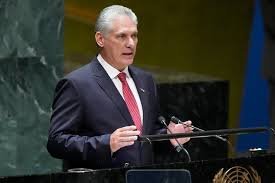
Cuba Stands Firm: President Díaz-Canel Responds to U.S. Pressure
Cuban President Miguel Díaz-Canel has asserted the island nation’s resolve to defend itself against potential U.S. military intervention, in a recent interview with NBC News’ Meet the Press. The comments come amidst escalating tensions and provocative statements from former U.S. President Donald Trump regarding Cuba’s future.
Defiance in the Face of Threat
Díaz-Canel, 65, firmly stated that the U.S. lacks justification for any military action against Cuba or attempts to remove him from power. He warned that an invasion would be costly, destabilizing for the region, and would be met with fierce resistance from the Cuban people, even at the cost of their lives. “If the time comes, there would be no justification for the United States to launch a military aggression against Cuba,” he declared, echoing the sentiment of Cuba’s national anthem: “Dying for the homeland is to live.”
Dialogue vs. Demands
While emphasizing Cuba’s willingness to engage in dialogue, Díaz-Canel rejected specific demands from the U.S., such as the release of political prisoners and the implementation of multi-party elections. He maintained that these matters are internal to Cuba’s political system and not subject to negotiation. When pressed about the case of Cuban rapper Maykel Osorbo, imprisoned since 2021 for a protest song, Díaz-Canel dismissed claims of widespread political imprisonment as “a big lie” and “slander” intended to discredit the Cuban Revolution.
A Question of Sovereignty
Responding to a hypothetical question about stepping down to “save Cuba,” Díaz-Canel challenged the premise, questioning whether such a question would ever be posed to other world leaders. He underscored Cuba’s sovereignty and independence, stating that its leaders are accountable to the Cuban people, not the U.S. government. “The concept of revolutionaries giving up and stepping down – it’s not part of our vocabulary,” he affirmed.
Accusations and Counter-Accusations
Díaz-Canel accused the U.S. of pursuing a “hostile policy” towards Cuba, arguing that the U.S. has “no moral authority to demand anything from Cuba.” He highlighted the economic hardships inflicted upon the Cuban people and the missed opportunities for a normal relationship between the two nations.
U.S. Response and Potential for Negotiation
A White House official, speaking on behalf of the Trump administration, indicated that discussions were underway with Cuba, suggesting that Cuban leaders “want to make a deal.” However, the official also characterized Cuba as a “failing nation” struggling with economic challenges and a loss of support from Venezuela.
Despite the tensions, both sides have expressed a willingness to explore avenues for dialogue. Cuba’s Deputy Prime Minister, Oscar Pérez-Oliva Fraga, indicated openness to commercial relationships with U.S. companies and Cuban-Americans. The ongoing negotiations aim to address bilateral differences and move away from confrontation.
Further Reading
For more in-depth analysis of U.S.-Cuba relations, consider exploring resources from The Council on Foreign Relations and The U.S. Department of State.