A Breathtaking New View of Interstellar Comet 3I/ATLAS
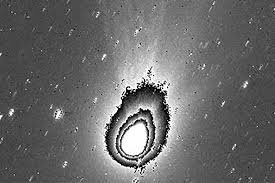
The European Space Agency (ESA) has unveiled a remarkable new image of the interstellar comet 3I/ATLAS, captured by its Juice spacecraft during its journey to Jupiter. This image provides unprecedented detail of the comet’s structure as it approached the Sun, offering valuable insights into these rare cosmic visitors.
Unveiling the Coma and Tail
The image, taken on November 6, 2025, when 3I/ATLAS was approximately 66 million kilometers away, showcases a brilliant halo of gas – known as the coma – surrounding the comet’s nucleus. A prominent tail extends outwards, adorned with rays, jets, streams, and filaments emanating from the comet itself. This dynamic display is a result of the comet releasing dust and gas as it’s heated by the Sun. The inset image highlights the intricate structure of the coma, revealing its complex composition.
(Image Credit: ESA/Juice/JANUS)
Juice’s Scientific Instruments in Action
This latest image was captured by Juice’s science camera, JANUS, a significant upgrade from the previous image taken by the spacecraft’s Navigation Camera in November 2025. During November, Juice employed a suite of five scientific instruments – JANUS, MAJIS, SWI, PEP, and UVS – to meticulously observe 3I/ATLAS. These instruments gathered a wealth of data, helping scientists understand the comet’s composition and behavior as it neared the Sun.
- JANUS: Captured over 120 images across a broad wavelength range.
- MAJIS & UVS: Gathered spectrometry data, analyzing the comet’s chemical makeup using light.
- SWI: Collected data on the comet’s composition.
- PEP: Captured particle data surrounding the comet.
A Comet Unlike Any Other
Comet 3I/ATLAS is a truly exceptional object. Discovered passing through our Solar System on July 1, 2025, it’s believed to be one of the oldest comets ever observed, potentially even predating our Sun. Originating from beyond our Solar System in another part of the Galaxy, it’s an interstellar comet – one of only three such objects discovered to date. This makes it a unique opportunity to study materials from a different star system.
The Journey to Jupiter and Beyond
The Juice spacecraft, currently en route to Jupiter, is designed to study the gas giant’s icy moons, which harbor subsurface liquid oceans and are considered prime candidates for extraterrestrial life. While on its journey, Juice seized the opportunity to observe 3I/ATLAS, providing invaluable data that will continue to be analyzed by ESA’s science teams. The data transmission was delayed due to Juice being on the opposite side of the Sun from Earth, but the information received in late February 2025 is already proving to be a treasure trove of scientific insights.
Learn more about the Juice mission at ESA’s Juice Mission Website and explore the wonders of comets at NASA’s Comet and Asteroid Page.
Iain Todd, Science Journalist