The University of Arizona: A New Standard for Responsible AI
The University of Arizona (U of A) is redefining the integration of artificial intelligence (AI) into higher education and society. Unlike a purely technical approach, the U of A prioritizes ethics, personal responsibility, and societal impact, fostering an ecosystem where integrity and human creativity remain central to progress. This human-centered approach positions the university as a national leader in the responsible adoption of AI technology.
Leading the Charge: The Office of Responsible AI
Spearheading this strategic effort is David Ebert, the U of A’s inaugural chief AI and data science officer. He leads the Office of Responsible Artificial Intelligence (ORAI), recognizing the need for leadership that emphasizes transparency and public trust in the rapidly evolving AI landscape.
“The challenges AI presents cannot be solved in isolation,” says Ebert. “Our approach ensures that as we advance our technical capabilities, we simultaneously deepen our commitment to the judicious application of these tools and the human insight that must guide them. We are building a future where AI serves as a partner in human progress, not a substitute for it.”
A Community-Driven Roadmap
The U of A’s AI integration process has been deliberate and inclusive. Throughout Fall 2025, ORAI engaged over 1,000 employees and students through listening tours, town halls, and surveys. Over 600 participants volunteered to shape the university’s strategic direction, resulting in a comprehensive AI roadmap set to be released this spring.
“We understand the demand for rapid implementation, but we are committed to doing this right the first time,” explains Rudy Salcido, associate director for operations and programs for ORAI. “This instills trust within our campus community and empowers everyone to engage with this transformative effort.”
A Flexible Framework for Continuous Improvement
The roadmap is designed to be dynamic, balancing immediate action with ongoing flexibility. It will adapt to technological advancements, emerging best practices, and evolving campus needs, ensuring a thoughtful and measured journey.
National Recognition and the Role of Public Universities
The U of A’s approach aligns with a broader national priority. The Association of Public and Land-grant Universities (APLU) highlighted public research universities as the “optimal partner” to lead the nation’s AI advancement in a March 2026 letter to the U.S. Department of Energy. Institutions like the U of A are uniquely positioned to curate scientific data and develop a workforce proficient in both AI and foundational sciences. Learn more about APLU’s initiatives.
AI in the Classroom and Beyond
The university’s philosophy is already evident in its curriculum. Instructors are integrating AI in ways that complement foundational learning. Jennifer Savary, co-director of the Lundgren Retail Collaborative, emphasizes the need for graduates who are resilient and lifelong learners, skills employers consistently seek.
Savary’s students begin with analog instruction to build core skills, then leverage AI-enabled methods to understand both the concepts and how AI shapes outcomes. Melody Buckner, associate vice provost for digital learning, highlights AI’s potential to free up instructors’ time for mentoring and personalized feedback. She successfully used AI to analyze student assignments and generate feedback, receiving positive responses from students.
The U of A AI Platform and Google AI Partnership
To scale AI integration, ORAI is launching the U of A AI Platform, built on Amazon Bedrock. This platform will provide a suite of AI tools to faculty, staff, and students across disciplines. The initial tool, U of A GenAI, offering access to large language models, is expected to roll out campus-wide by the end of March. The university is also participating in the Google AI for Education Accelerator, introducing AI-fluency training to incoming freshmen.
AI-Driven Research and Innovation
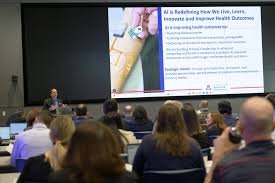
AI is central to the university’s strategic research priorities, particularly in AI-driven health innovation. Supported by the Arizona Board of Regents, faculty from diverse disciplines are applying AI to medical imaging, precision medicine, energy optimization, and national security. The Arizona Institute for AI and Society provides the technical infrastructure to translate research concepts into measurable outcomes.
The Arizona AI Leadership Summit
The collective momentum will be showcased at the Arizona AI Leadership Summit on March 18, bringing together leaders from Arizona’s public universities, Pima Community College, and various sectors to explore responsible AI integration for public benefit.
“We are building a future where every member of our community has the fluency to navigate this new era with confidence and integrity,” concludes Ebert.
The University of Arizona acknowledges that it is on the land and territories of Indigenous peoples.