Kinshasa’s Street Children: A Fight for a Future
In the courtyard of an old warehouse in Kinshasa, children roam among rusted car carcasses. These are the “shégués,” street children attempting to survive in the capital of the Democratic Republic of Congo (DRC). Non-governmental organizations (NGOs) are working tirelessly to offer these vulnerable youth a chance at a future.
Abandoned by their parents or fleeing poverty, the “shégués” number in the thousands, surviving through resourcefulness and begging at intersections and along the bustling streets of this megacity of nearly 17 million inhabitants. “The hemorrhage is deep; we encounter new cases every day,” says Georges Kabongo, an educator who has been organizing outreach programs for the Œuvre de reclassement et de protection des enfants de la rue (ORPER) for over 11 years. Every day, his team patrols the capital’s impoverished neighborhoods, providing care and assistance to the most vulnerable.
A Cycle of Violence and Exploitation
Inside a 4×4, a nurse from the NGO disinfects a deep gash on a young boy’s arm. His legs are also scraped. “They cut him with a razor blade. They do that to newcomers,” explains Willie Masalé, wearing a white coat. Nearby, a young girl lies unconscious in the back of a pickup truck. Another, just 13 years old, hides her pregnancy under a dirty sweater.
In Limete, a popular district in eastern Kinshasa, violence, drugs, and prostitution are daily realities for the “shégués.” “Girls are also victims of rape. We raise awareness about the risks of infection and HIV contamination,” emphasizes Georges Kabongo. The mobile team assists over 800 minors annually. Many are accused of being “witch children” by their families, often as a pretext to abandon them, as Kabongo laments.
The Root of the Problem: Poverty and Superstition
According to the World Bank, nearly 75% of the DRC’s population lives on less than three dollars a day. In the capital, evangelical churches are flourishing, and false pastors claim they can “exorcise” “witch children” for a fee. “Some even go so far as to sequester them, deprive them of food, and subject them to unbearable practices,” denounces the educator.
An 11-year-old girl approaches, barefoot. Her body is covered in scars. “My family poured boiling oil on me,” she recounts, having fled two years ago with her two older sisters. The mobile team tries to convince her to stay at one of the NGO’s shelters, where she can receive food and lodging.
Empowering Through Education and Training
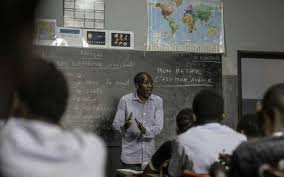
Another organization, the Œuvre de suivi, d’éducation et de protection des enfants de la rue (OSEPER), focuses on training to “restore hope” to these rejected children. “When you graduate, you can become entrepreneurs,” the French teacher tells students at an OSEPER training center. The association offers literacy lessons for the youngest and vocational training. Around a hundred young people are learning carpentry, sewing, and baking.
“When they reach adulthood, they can work and become self-sufficient. The goal is for these children to reintegrate into society and become useful members,” says Christophe Moké, an OSEPER educator.
In the kitchen, Daniel is shaping dough. Before being abandoned by his mother and grandmother, he dreamed of becoming a church singer. But after experiencing the violence of the streets, the 17-year-old now aspires to a “stable life.” “I often cry at night when I think about the past,” he confesses, recalling months spent in a gang of “shégués.” “There, you have to be brutal like them. You are beaten every day and have to steal to eat. I regret many things I’ve done,” says the teenager, who hasn’t heard from his family in a while.
“NGOs are doing the work of parents and the state,” says Désirée Dila, a supervisor at the center. Lacking funding, the association relies on private donations and external partners, such as the French foundation Apprentis d’Auteuil, to operate. The teams are concerned about a decline in funding for their activities, amid a global reduction in humanitarian aid.
Source: AFP