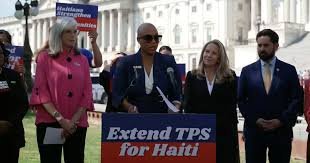
House Votes to Extend TPS for Haitian Nationals, Challenging Trump Administration
Washington D.C. – In a rare display of bipartisan pushback, the House of Representatives on Thursday approved a bill to prevent the Trump administration from ending Temporary Protected Status (TPS) for Haitian nationals residing in the United States. The vote marks a significant moment in the ongoing debate over immigration policy and the future of hundreds of thousands of individuals.
The effort to force a vote was spearheaded by Democratic Representative Ayanna Pressley of Massachusetts, utilizing a procedural tool known as a discharge petition. This tactic, gaining traction amidst a fractured House Republican majority, successfully garnered the necessary 218 signatures to bypass GOP leadership and bring the measure to the floor in late March.
Bipartisan Support for TPS Extension
The discharge petition received support from four Republicans – Representatives Maria Elvira Salazar of Florida, Brian Fitzpatrick of Pennsylvania, Mike Lawler of New York, and Don Bacon of Nebraska – alongside all Democrats. Further bolstering the effort, Representatives Nicole Malliotakis of New York, Carlos Gimenez of Florida, and Kevin Kiley of California added their support in a procedural vote on Wednesday.
The bill, originally introduced by Democratic Representative Laura Gillen of New York, mandates that the Department of Homeland Security (DHS) extend TPS for Haitians until 2029. Representative Lawler also cosponsored the legislation.
Vote Breakdown and Key Supporters
The final vote tally was 224 to 204, with 11 Republicans joining all Democrats in favor. Additional Republican support came from Representatives Mike Carey of Ohio, Mario Diaz-Balart of Florida, Rich McCormick of Georgia, and Mike Turner of Ohio.
Interestingly, the bill echoes a proposal made by Secretary of State Marco Rubio in 2019 during his time as a Florida senator, highlighting a degree of bipartisan consensus on the issue.
Legal Battles and Supreme Court Review
This vote arrives as the Supreme Court prepares to review the legal challenges to the Trump administration’s attempts to revoke TPS for immigrants from Haiti and Syria. A federal judge previously blocked the administration from ending protections for Haiti in February, and an appeals court upheld that decision.
Understanding Temporary Protected Status (TPS)
Established in 1990, the TPS system allows immigrants to temporarily live and work in the U.S. without fear of deportation if their home country is deemed unsafe due to armed conflict, environmental disasters, or other extraordinary circumstances. Haiti’s designation has been repeatedly extended since the devastating 2010 earthquake, which claimed over 300,000 lives. The Biden administration most recently extended the designation in August 2024 for 18 months, citing ongoing economic, security, political, and health crises in Haiti.
As of last year, over 330,000 Haitian nationals held TPS status, excluding those who also possess green cards.
Trump Administration’s Stance and Concerns
The Trump administration has actively sought to terminate TPS protections for Haiti and other countries, requiring Haitian nationals to leave unless they qualify for alternative immigration pathways. In a November notice, the administration argued that Haiti’s designation was “contrary to the U.S. national interest.”
The notice stated, “The United States cannot call for bold change on the ground while signaling doubt from afar. Our immigration policy must align with our foreign policy vision of a secure, sovereign, and self-reliant Haiti and not a country that Haitian citizens continue to leave in large numbers to seek opportunities in the United States,” while acknowledging the concerning situation in Haiti.
Lawmakers Express Concerns for Safety
Lawmakers have voiced concerns that the Trump administration’s decision would endanger lives. Representative Pressley described the decision as “a death sentence,” and Representative Gillen called it “cruel to expect Haitians to be forced to return to these deadly, dangerous conditions.”
Representative Lawler emphasized the injustice of sending individuals back to unsafe conditions when they are lawfully present in the U.S., noting the State Department’s warning against American travel to Haiti, which contradicts DHS’s assessment of safety for Haitian immigrants.
Next Steps and Potential Challenges
The legislation now heads to the Senate, where its fate remains uncertain. Even if passed by the Senate, it faces a potential veto from President Trump. Overriding a presidential veto requires a two-thirds majority in both chambers of Congress, a threshold that proved difficult to reach earlier this year on other legislation.
Further Reading: U.S. Department of State – Haiti