
Beyond the Myth: Was the Trojan War Actually Real?
For centuries, the story of the Trojan War—a decade-long siege fueled by love, betrayal, and a clever wooden horse—was relegated to the realm of mythology. Found in the pages of Homer’s Iliad and Odyssey, these tales shaped Western civilization. But for those who travel to the northwestern tip of Türkiye, the line between legend and history begins to blur.
Visiting the site of Troy is less like a history lesson and more like time travel. As you drive south from the charming port town of Çanakkale, signs for “Truva” and “Troya” guide you toward a landscape that feels eerily familiar to anyone who has read the classics.
The Archaeology of Hisarlik: A City of Many Layers
The ruins lie on a hill known as Hisarlik (Turkish for “place of fortresses”). What makes this UNESCO World Heritage site so fascinating is that it isn’t just one city—it is nine. Archaeologists have discovered nine different cities that rose, fell, and were built upon one another over millennia.
When asking “was the Trojan War real?”, researchers point specifically to Troys 6 and 7. These layers are believed to be the settings for Priam’s Ilium. The evidence is compelling: excavations have revealed destruction layers containing burned materials, skeletons, arrowheads, and slingstones—all hallmarks of a violent conflict consistent with the Bronze Age.
Does the Landscape Match the Legend?
While definitive “smoking gun” proof of the mythical Trojan Horse remains elusive, the geography provides a powerful argument for the war’s reality. Professor Rüstem Aslan, who has spent four decades excavating the site, notes that the landscape is almost an exact mirror of Homer’s descriptions.
- n
- The Topography: The presence of two rivers, specific mountains, and nearby islands aligns perfectly with the epic poems.
- The Atmosphere: Professor Emily Wilson of the University of Pennsylvania describes the site as a “windy city,” exactly as Homer depicted it.
- The Scale: The flat plains surrounding the city allow visitors to imagine the massive armies of the Achaeans and Trojans clashing in battle.
Visiting Troy: A Traveler’s Guide
If you are planning a trip to uncover the secrets of the ancient world, here is the best way to experience the site:
1. Start at the Troy Museum
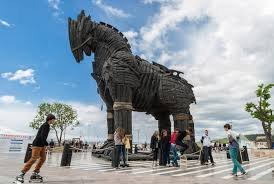
Before walking through the ruins, visit the state-of-the-art Troy Museum. It houses approximately 2,000 Bronze Age artifacts and provides an essential guide to understanding the various city layers. Outside, you’ll find a towering replica of the Trojan Horse, reminding us of the legend that brought the world to this hilltop.
2. Explore the Ruins and Schliemann’s Trench
Walk through the preserved Late Bronze Age ruins, which are among the best-preserved in the Mediterranean. Don’t miss Schliemann’s Trench—the site where Heinrich Schliemann first began digging in 1871. Though his aggressive methods destroyed some of the very layers he sought, his work proved that Troy was a physical place, not just a poetic invention.
3. Escape to Çanakkale
The nearby town of Çanakkale is the perfect base for your stay. Enjoy the lively marina, visit the movie-prop Trojan Horse from the 2004 film Troy, or take a ferry to explore the Gallipoli battlefields. For a taste of local culture, try the bahk şiş (fish shish kebab) at a seaside restaurant.
Final Thoughts: Fact or Fiction?
So, was the Trojan War real? While we may never find a diary entry from Achilles or a blueprint for the wooden horse, the archaeological evidence suggests a historical core. The burned walls, the strategic location, and the matching geography tell us that a great conflict likely occurred here. Troy remains a place where history and myth dance together, proving that some legends are rooted in a very tangible truth.



