
The Survivor Tree: A Living Symbol of Resilience After the Oklahoma City Bombing
Tragedy often leaves behind scars that seem permanent, but occasionally, nature provides a powerful reminder that life persists. In the heart of Oklahoma, one American elm tree stands as a testament to the human spirit. Nearly destroyed during the Oklahoma City bombing, this tree has evolved from a simple shade provider into a global icon of resilience and healing.
What is the Survivor Tree?
Before the devastating events of April 19, 1995, the tree was just a regular part of the parking lot at the Alfred P. Murrah Federal Building. However, after the blast, it became one of the few living things to survive the devastation. Today, it is meticulously cared for at the Oklahoma City National Memorial & Museum, where its health is closely monitored as a living tribute to those lost and those who survived.
More than just a monument, the Survivor Tree has become a source of new life. Through the production of seeds and saplings, its legacy is being planted across the United States, linking distant cities and people to a story of survival and strength.
Spreading Hope: Saplings Across the Nation
The gift of a Survivor Tree sapling is more than a botanical gesture; it is a symbol of shared endurance. Several high-profile locations and figures have welcomed these descendants:
- n
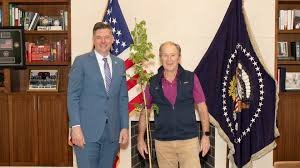
- The George W. Bush Presidential Center: In 2026, Mayor David Holt presented a sapling to former President George W. Bush. It now finds its home in the Laura W. Bush Native Texas Park, honoring the Bush family’s long-standing support for the city.
- Oklahoma’s Urban Parks: To keep the legacy close to home, saplings were planted at Scissortail Park in Oklahoma City and The Gathering Place in Tulsa.
- The U.S. Capitol: On the 30th anniversary of the bombing, a descendant was planted at the U.S. Capitol, standing as a living reminder of strength in the seat of American government.
- Spiegel Grove: A peace ceremony in Fremont, Ohio, saw a sapling planted on the grounds of the Rutherford B. Hayes Presidential Library and Museums.
A Bond of Shared Survival: OKC and 9/11
The connection between the Oklahoma City bombing and the September 11 attacks is a profound one. In 2006, a sapling from the Survivor Tree was planted in the Living Grove Memorial Park at the foot of the Brooklyn Bridge in New York City.
In a beautiful exchange of resilience, the 9/11 Memorial and Museum shared a sapling from their own survivor tree—a Callery pear tree found at Ground Zero. This NYC sapling was planted at Oklahoma Christian University, side-by-side with a descendant of the Oklahoma elm, creating a permanent bond between two cities that faced unimaginable loss.
A Universal Message of Peace
The reach of the Survivor Tree extends even further, touching sites of global remembrance. The Dallas Holocaust and Human Rights Museum requested a sapling to create a bridge between the victims of the Holocaust and those affected by the 1995 tragedy, noting that both events occurred on April 19th in different years.
Whether it is in a presidential park, a national capitol, or a museum of human rights, the descendants of the Survivor Tree remind us that while hate can destroy, the will to survive and grow is far more powerful.
Interested in carrying this legacy forward? The Oklahoma City National Memorial & Museum offers seed kits and saplings to the public, allowing anyone to plant a symbol of hope in their own backyard.



