
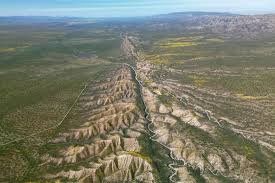
The Big One: Why the San Andreas Fault is at a 1,000-Year Stress Peak
It sounds like a plot straight out of a Hollywood blockbuster: a catastrophic earthquake ripping through the West Coast, leveling infrastructure, sparking uncontrollable fires, and triggering massive landslides. While these images are common in cinema, for residents from San Francisco to Los Angeles, the threat of a major earthquake in San Francisco or Southern California is a scientific reality that demands urgent attention.
Recent geological findings have sent a ripple of concern through the scientific community. Researchers now warn that a future seismic event could be far more widespread and devastating than previous models suggested. The core of the issue? The southern portions of the San Andreas fault and the adjacent San Jacinto fault line are currently “locked and loaded,” reaching stress levels not seen in a millennium.
The “Earthquake Gate”: A Recipe for Disaster
For years, geologists have monitored the friction between the Pacific and North American tectonic plates. However, a new study highlights a dangerous junction known as the Cajon Pass. This area acts as an “earthquake gate,” meaning it can either block a rupture or act as a bridge, allowing a quake to jump from one fault line to another.
- n
- Single-Fault Event: A localized quake that causes significant but contained damage.
- Joint Rupture: A scenario where the “gate” opens, causing the San Andreas and San Jacinto faults to rupture simultaneously.
If a joint rupture occurs, scientists predict a magnitude between 7.4 and 7.8. Such an event would not just impact one city, but would cascade through Los Angeles, San Bernardino, Riverside, and the Coachella Valley all at once, crippling critical highways, railways, and energy corridors.
By the Numbers: A 1,000-Year High
To understand the gravity of the situation, researchers reconstructed 1,000 years of seismic activity. The data is startling. The San Jacinto Bernardino segment is currently registering 3.6 megapascals of stress—the highest level recorded in the last millennium.
Similarly, the Mojave South segment of the San Andreas fault has surpassed its own record stress load from a decade ago. According to geophysicist Liliane Burkhard, the balance of stress across the Cajon Pass junction is now reaching a configuration that historically triggers massive, interconnected ruptures.
Beyond the Panic: The Urgency of Preparation
While the prospect of a massive earthquake in San Francisco or Southern California is daunting, the goal of this research is not to spark panic, but to drive action. The reality is that the probability of a 6.7-magnitude or higher earthquake hitting the southern stretch of the San Andreas fault in the coming decades is over 50%.
Experts argue that city managers and emergency responders can no longer treat a joint rupture as a “worst-case scenario,” but must instead view it as a realistic possibility. Updating building codes, reinforcing infrastructure, and enhancing emergency response plans are no longer optional—they are essential for survival.
For more information on how to secure your home and stay safe during seismic activity, visit the United States Geological Survey (USGS), the leading authority on seismic monitoring in the US.
The bottom line: Southern California and the rest of the West Coast face a growing seismic risk. The time to prepare is now—not after the ground begins to shake.



