NASA Curiosity Gediz Vallis Discovery: The Mystery of the Pure Sulfur Rocks on Mars
A Splash of Yellow on the Red Planet: A Geological Shock
Mars has always been a land of surprises, but even for the seasoned scientists at NASA, some discoveries are truly “preposterous.” While we have a broad understanding of Martian geology, the NASA Curiosity Gediz Vallis discovery proves that the Red Planet still holds secrets just beneath its dusty surface.
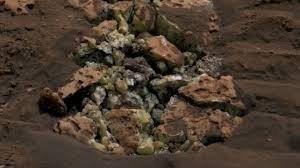
In a startling moment in 2024, the 899-kilogram Curiosity rover rolled over a seemingly ordinary rock in the Gale Crater’s Gediz Vallis Channel. When the rock cracked under the rover’s weight, it revealed something unexpected: crystals of startlingly pure elemental sulfur, also known as brimstone.
Why This Discovery Is a Game-Changer
To understand why this is such a big deal, we have to look at the chemistry. Scientists have long found sulfates (salts containing sulfur and oxygen) on Mars. However, finding sulfur in its pure elemental form is a first. As Ashwin Vasavada, a Curiosity project scientist, aptly put it: “Finding a field of stones made of pure sulfur is like finding an oasis in the desert.”
On Earth, pure sulfur is typically linked to high-temperature volcanic or hydrothermal activity. The puzzle? There is no evidence that Gediz Vallis ever experienced the extreme heat required to create these deposits. This gap in knowledge led to two groundbreaking studies published in 2026.
Two Theories: How Did the Sulfur Get There?
Researchers are now racing to explain how these fragile yellow crystals survived for billions of years. Two primary theories have emerged:
1. The Trapped Gas Hypothesis
A study led by Scott VanBommel and published in Science suggests a fascinating process involving ancient volcanic gases. The theory proposes that:
- Volcanic gases were released and became trapped beneath the surface in ice-like cages called clathrates.
- As erosion carved out the Gediz Vallis, the pressure dropped, allowing the gases to escape.
- Chemical reactions occurred at lower temperatures, crystallizing the pure sulfur.
This process likely happened between 3.1 and 2.8 billion years ago, leaving the sulfur intact for eons.
2. The Cold Chemical Reaction
Alternatively, a study in Geophysical Research Letters led by Jiawei Wang suggests a more “liquid” origin. By simulating ancient Martian conditions, the team found that mixing dissolved sulfide with chlorate in acidic water at room temperature could produce pure sulfur crystals.
This means that the sulfur could have formed through water-based chemistry without needing volcanic heat or the presence of biological organisms.
The Big Question: Does This Mean Life?
While these studies show that pure sulfur can form through non-biological processes, the discovery is still electrifying for astrobiologists. Sulfur is a fundamental building block for life; many organisms use it to create essential amino acids for proteins.
Although we haven’t found “smoking gun” evidence of Martian microbes yet, the NASA Mars exploration missions keep uncovering the exact ingredients life needs: water, complex chemistry, and habitable conditions.
📰 You May Also Like