
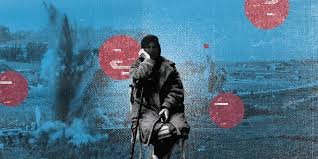
Israel-Iran War: The Erosion of Life in Southern Lebanon
At the heart of this unfolding tragedy are the resilient people of Southern Lebanon, whose homes have been repeatedly destroyed – more than four times over. Historically, each devastation was met with rebuilding, a testament to the enduring human spirit and the refusal to postpone life. But today, a chilling shift has occurred. The focus is no longer on reconstruction, but on something far more profound and heartbreaking: forgetting. Memory itself has become a burden, a weight too heavy to bear.
Survival is no longer found in the act of rebuilding, but in the desperate attempt at erasure. As Israeli evacuation orders continue, warning of the demolition of border villages and prohibiting return, the situation transcends mere military procedure or security measures. It appears, instead, as a deliberate attempt to erase existence itself, to uproot people from the land that defines them.
The Land as More Than Property
This uprooting frames everyone as expendable, suggesting the land is something to be seized, buried, and ultimately, annihilated. The target isn’t simply the physical place, but the very relationship that binds people to their ancestral land. A critical question emerges: what *is* land today? Villages, towns, and displaced residents are no longer just elements in a recurring cycle of war; they’ve become part of a deeper transformation, challenging the very meaning of land itself – not just for those who inhabit it.
It’s as if the current events are forcing a redefinition of land, moving beyond concepts of property or geography, and framing it as a fundamental condition for life itself. Simultaneously, within the mindset of the “resistance,” land is viewed through a different lens: a defensive position, a strategic depth, a line of contact. This shift prioritizes conflict over the lives and rights of the people who call it home. Land’s value becomes tied to its military function, eclipsing the lives, relationships, and meanings it holds. The people within it are seen as an excess, a complication.
A Slow Dismantling of Societies
The land appears to possess worth only in the context of war, losing its value in the realm of life. Once vibrant with people, seasons, and everyday details, it gradually loses its civility. War, as it’s understood today, is no longer a confrontation between armies, but a slow dismantling of societies, targeting not only people but the very bonds that make life possible. The land isn’t just destroyed; its relationship with those who live on it is unraveled, reduced to an operational field, read as coordinates and managed as a network of targets, rather than a space for living.
However, what’s unfolding goes even deeper. It’s not merely a dismantling of society or a militarization of space, but a hollowing out of the land’s life-sustaining function *before* it’s even destroyed. Houses may remain standing, but they are either ruined or abandoned, uninhabited. The land still exists, yet it’s no longer cultivated, as if life itself is suspended, not fully extinguished.
Loss as an Ongoing Condition
Loss is no longer an event that *occurs*, but an ongoing condition that gradually drains the place of its meaning. It’s not just that rights are denied to people, but to the land itself – its right to be a space for living. The place transforms from a simple, everyday environment into a site of endurance, a fixed point of sacrifice, an archive of memory, speeches, and statements. It becomes defined by historical and conflict-driven function, rather than by life itself.
This creates a fundamental ambiguity. The claims of “resistance” exist alongside the denial of people’s rights, their work, and their ability to determine the fate of their land. Compensation, regardless of its scale, always falls short of the actual loss, because what’s lost isn’t just a house or a piece of land, but an entire relationship to living and working.
Two Trajectories, One Outcome
Two trajectories intersect in outcome: one Israeli, which destroys and dispossesses through force and fear; and another internal, which suspends the function of ownership itself and postpones life in the name of conflict. Can land be defended by keeping it permanently within the context of war? In its essence, land isn’t merely a stage for conflict, but a web of names, stories, symbols, and relationships, where people’s lives are intertwined with their memories.
But when land is burdened with narratives of blood and resistance, everyday life is pushed to the margins. This logic constructs the “mythical” at the expense of the “real,” accumulating grand narratives while allowing a slow disintegration of life’s networks within families, relationships, and people’s sense of stability. Between externally imposed destruction and internally reshaped militarization, land is gradually stripped of being a lived space, reduced to a site of conflict.
What’s happening in Southern Lebanon isn’t a clear struggle *over* land, but a distorted reduction *of* it – from a plural space of life into a single function, either as a narrative or as a target for annihilation. In both cases, it’s not only the place that’s lost, but the world that once existed through it. Land shifts from something lived to something used or spoken about. The South is no longer land, but an idol, invoked or narrated, yet no longer lived.
Israel is systematically redefining land, not as a place to be lived in, but as a matrix of targets, taught and processed as a dotted map, divided, monitored, and then struck. Homes are read as coordinates, villages reduced to points – a technical designation that renders them calculable rather than livable. Details are erased in favor of calculation, replaced by a language of numbers and signals. The land becomes a silent map, not an inhabited world, its value precisely known in war, yet stripped of its worth as life.
What’s taken away isn’t just the place, but the capacity to act. Before the land itself is lost, what makes it livable is stripped away: the ability to refuse, to try, to negotiate. Everything is managed as a procedure, an alert, a message, a warning, a call. Decisions aren’t issued as part of a conflict, but as ready-made commands. The land of the South is not only bombed; it’s reduced to data, where existence itself becomes something that can be tracked and suspended. This is a rationality that doesn’t liberate, but administers, turning land and people into objects to be controlled rather than lives to be lived.
Israel doesn’t just dispossess; it does so before ownership can even be exercised. The individual is no longer able to claim their right. The capacity to act is stripped away before action itself. The South, in its small way, begins to resemble a trace on a screen, rather than a world alive with life. A house still stands, yet no one lives in it. Land remains, yet it is not cultivated. Ownership without use, as if it never existed. A road is bombed, and everything stops: no exit, no return, only waiting. A farming season is cancelled, and what will the displaced southern farmer wake up to? No water, no crops, no slope to till, no tending of the land. A school worker returns to find no students; they have scattered, like the homes themselves.
In a café in Beirut, two friends ask, simply: Was your house destroyed? The answer comes without emotion: No, but another house collapsed on top of it. Everything remains standing in form, yet is lost in reality, as if life itself is suspended without disappearing. The collapse of the southern communities’ primary worlds enters directly into the intuitive imagination of life. The catastrophe is reduced to an everyday sentence, as if it were part of the language itself. Some no longer even care whether the house still stands, as if everything has been surrendered to powers beyond their control. A world violated over and over until it loses its sense of astonishment.
The destruction of a home in the South cannot be understood from the outside. It is not merely the loss of a place, but the disintegration of something deeper than language. Language itself shifts, from empathy to irony, from shock to habit. Irony is not weakness, but an attempt to grasp and contain what cannot be understood. With repeated trauma, aspiration shrinks to the bare minimum. Short sentences. Brief replies. Breaks in speech. Language itself begins to erode. The catastrophe becomes part of everyday life, not because people have accepted it, but because it can no longer be explained. Over time, it is not only the house that collapses, but the rhythm upon which life was built. A constant waiting for a strike that could come at any moment. The land shifts from a source of safety to a source of threat. Supporters of the resistance may see the South as a site of steadfastness, yet it appears fragile, a steadfastness repeated until it is emptied of meaning. A daily rhythm of strikes and waiting. Even when Israeli strikes come selectively, they do not reinforce this meaning, they break it.
At the heart of this are southerners whose homes have been destroyed more than four times. Each time, they rebuilt, because life cannot be postponed. Today, they are no longer thinking of rebuilding, but of something simpler: to forget. Memory itself has become a burden. Survival is no longer in reconstruction, but in erasure. In a village like Aïn Ebel, three young men carry no weapons and want none; they simply want to remain. Even this minimum has become impossible. What is happening is not only bombardment and destruction, but an ongoing unraveling that people try, unsuccessfully, to resist. There is no space for rest. The South is not only a targeted geography, but a collapsing world. A language growing tired, perhaps disappearing into silent, exhausted faces. A human being living inside a continuous collapse.



