
Beyond Caracas: The Heartbreaking Reality of Venezuela’s Economic Collapse in Cumaná
While the world often looks at Venezuela through the lens of its capital, Caracas, there is a stark and devastating divide that the headlines often miss. While Caracas currently experiences a strange, isolated boom attracting oil tycoons and crypto-investors, the rest of the country is weathering a storm of decay. Nowhere is this more evident than in Cumaná.
Once a crown jewel of the nation’s industrial base, Cumaná now resembles a war zone. However, the ruins here weren’t caused by missiles or bombs, but by decades of economic mismanagement, ideological vengeance, and systemic collapse.
A City Compared to a War Zone
Walking through Cumaná today is a haunting experience. Potable water is a luxury, daily power outages are the norm, and the halls of its once-illustrious university are now silent, save for the wind whistling through looted remains. Local residents, some with a touch of dark humor, have compared their city to Kyiv—not because of active shelling, but because of the sheer scale of the devastation.
The Rise and Fall of an Industrial Powerhouse
To understand the tragedy of Cumaná, one must remember what it once was. During its peak, the city was a regional epicenter for the Caribbean basin, specializing in:
- n
- Fishing and Canning: A massive processor of tuna and sardines for all of South America.
- Shipbuilding: Thriving yards that built commercial fishing vessels.
- Automotive Manufacturing: The proud home of a Toyota plant that produced the legendary Land Cruisers.
The decline began with a wave of state expropriations under the guise of building a socialist economy. By removing private capital, the government inadvertently strangled the very industries it sought to control. The canning industry collapsed when state-run suppliers failed to provide basic materials like metal cans, leaving factories to rot in neighborhoods like Caigüire.
The Human Cost: A Struggle for Survival
Today, the manufacturing sector is a ghost of its former self. Cumaná now depends almost entirely on government subsidies, which are woefully insufficient against the backdrop of hyperinflation.
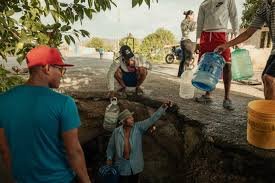
The crisis reached a breaking point in February when a tunnel collapse crippled the water supply system. The resulting water rationing has turned the arrival of water tankers into scenes of chaos. Desperate residents plead for drops of water while soldiers with semi-automatic rifles stand guard to prevent riots.
The economic burden is crushing:
- A single 20-liter container of water from private tankers can cost up to $8.
- For families living on low wages and a meager government subsidy of $240 a month, this cost is unsustainable.
- Schools have been forced to suspend classes due to a lack of basic sanitation.
A Long Road to Recovery
The story of Cumaná is a cautionary tale of how political ideology, when decoupled from economic reality, can destroy a thriving city in less than a generation. While the political landscape in Venezuela may be shifting, the physical and economic ruins of the interior suggest that the road to recovery will take decades, if not generations.
For more in-depth reporting on the systemic issues facing the region, you can explore the archives of the New York Times.



