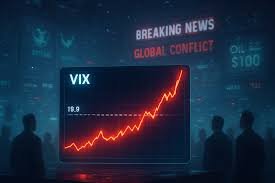
VIX Spike: A Return to Market Volatility in 2026
The relative calm that characterized the beginning of 2026 has abruptly ended, giving way to a significant increase in market volatility. In early March, the CBOE Volatility Index (VIX), widely known as Wall Street’s “fear gauge,” surpassed the critical 19.9 level – a key threshold historically indicating a shift from market complacency to heightened alert. This surge coincided with a sharp decline in retail investor confidence, with the CNN Fear & Greed Index plummeting to 19.97, firmly placing the market in “Extreme Fear” territory as of March 18, 2026.
Capital Rotation and the Geopolitical Landscape
The immediate consequence of this volatility is a substantial shift in capital away from high-growth technology stocks and towards defensive sectors like energy and aerospace. Brent crude oil prices have surged past $100 per barrel due to escalating military operations in the Middle East, creating a dual challenge for investors: a geopolitical “war premium” and a Federal Reserve facing the threat of stagflation.
The VIX reaching 19.9 wasn’t just a number; it was a warning signal that brought the AI-driven rally of the previous year to a halt. The primary catalyst for this sudden increase in volatility was the launch of “Operation Midnight Hammer” on February 28, 2026, a coordinated military operation by U.S. and Israeli forces targeting Iranian missile and drone infrastructure following maritime provocations. Iran’s subsequent blockade of the Strait of Hormuz has severely disrupted global oil supplies, sending shockwaves through energy markets.
Multiple Pressure Points: Beyond the Middle East
While the Middle East is currently the focal point of market anxiety, it’s not the only source of concern. The Russia-Ukraine conflict has reached a critical juncture in its fifth year, with potential forced territorial concessions in the Donbas region adding another layer of uncertainty. Simultaneously, maritime disputes in the South China Sea involving the Philippines (the 2026 ASEAN Chair) and Chinese sovereignty claims are straining U.S. naval resources, raising fears of a security vacuum that could disrupt global semiconductor trade.
Retail Investor Sentiment and Market Bifurcation
Retail investors, who had largely anticipated a “soft landing” and Federal Reserve rate cuts in late 2025, have been caught off guard by this convergence of risks. The AAII Sentiment Survey, as of March 11, revealed a surge in bearish sentiment to 46.4%, up from 35.5% just two weeks prior. This rapid shift suggests a significant de-risking trend, with retail investors moving away from speculative stocks towards traditional safe havens.
The market has clearly bifurcated in this high-volatility environment. The primary beneficiaries are companies in the defense and energy sectors. Lockheed Martin (NYSE: LMT) and Northrop Grumman (NYSE: NOC) have reached record highs as global defense budgets are adjusted for a multi-theater conflict scenario. Palantir Technologies (NYSE: PLTR) has rebounded 14% this month, as its technologies are reportedly being used for real-time battlefield analysis.
The energy sector is also proving resilient. ExxonMobil (NYSE: XOM) and Chevron (NYSE: CVX) have significantly outperformed the S&P 500 in March, with Chevron up 22% year-to-date. These companies are benefiting from higher crude prices and a renewed focus on domestic production security. Volatility-tracking products, like the VIX Short-Term Futures ETF (BATS:VXX), have seen increased trading volumes as investors seek to hedge against further spikes.
Losers in the VIX Spike
Conversely, high-multiple technology stocks that led the 2025 rally are suffering. Microsoft (NASDAQ: MSFT) has entered a technical bear market, down 27% from its peak, as investors question the return on investment for large AI expenditures in a high-energy-cost environment. Retail favorites like AMC Entertainment (NYSE: AMC) have hit new 52-week lows, while GameStop (NYSE: GME) remains under pressure as the market shifts away from speculative assets.
The New Normal: Geopolitical Multiplexing and the Fed’s Dilemma
This volatility aligns with a broader trend of “geopolitical multiplexing,” where multiple regional conflicts occur simultaneously, making it difficult for the Federal Reserve to rely on traditional economic models. The Fed, led by Jerome Powell in his final year, currently maintains interest rates in the 3.5%–3.75% range. However, the oil shock has created a stagflationary scenario: a weakening labor market combined with persistent inflation driven by energy prices.
Historically, a VIX level of 20 has often prompted the Fed to adopt a more dovish stance to support market liquidity. However, the current situation is more akin to the 1970s oil shocks than the 2008 financial crisis. Cutting rates to support the economy risks fueling energy-driven inflation, while maintaining or raising rates could trigger a deeper recession. This policy paralysis is contributing to the “Extreme Fear” observed in retail sentiment.
Looking Ahead: Uncertainty and Resilience
The remainder of Q2 2026 is likely to be characterized by “grinding uncertainty.” The market is currently pricing in a protracted conflict but hasn’t fully accounted for a global recession. Investors should prepare for heightened intraday swings, as even minor developments can cause significant market movements. The spike in the VIX to 19.9 marks the end of the 2025 bull run. Diversifying into defensive industries and exercising caution with high-growth technology stocks are crucial strategies.
Disclaimer: This content is intended for informational purposes only and is not financial advice.