A New Chapter: Prime Minister Carney’s Reset of Canada-India Relations
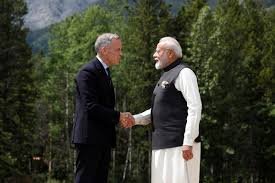
You might recall the images of former Prime Minister Justin Trudeau’s visit to India in 2018, a trip intended to revitalize relations. Before that, Stephen Harper initiated free-trade talks in 2010, talks that ultimately stalled. Canada-India relations have often been a complex interplay of ambition and disappointment. Now, as Prime Minister Mark Carney embarks on his own visit, there’s a growing sense that this time, things could be different.
For years, India has been courted for trade agreements, often without concrete results. However, the global landscape is shifting. India has recently finalized a significant trade deal with the European Union, driven by a desire to diversify amidst the uncertainties of global trade, particularly those stemming from U.S. trade policies. This creates a unique opportunity for Canada. Mr. Carney may be poised to announce the commencement of trade talks with a genuine prospect of success.
A History of Missed Opportunities
“The history of Canada-India relations is one of many missed opportunities, roadblocks and mistrust,” observes Vina Nadjibulla, Vice-President of the Asia-Pacific Foundation. “But there’s also a lot of potential in the relationship.” The relationship has swung dramatically, from periods of cordiality to significant setbacks.
A critical question remains: what does the relationship truly mean for both nations? Are we reliable economic partners, security allies, or simply wary trade opportunists? Prime Minister Carney, in his January speech at Davos, emphasized the importance of calibrating international relationships based on shared values. However, his visit to India comes in the wake of serious allegations – accusations that agents of India were involved in the killing of Canadian citizen Hardeep Singh Nijjar in British Columbia.
Navigating Sensitive Issues
India has consistently expressed concerns regarding the presence of pro-Khalistan activists within the Sikh-Canadian community, individuals advocating for a separate state in northern India. In 2024, the RCMP alleged Indian government involvement in a series of crimes within Canada, suggesting a shift towards transnational repression. While Mr. Carney has largely avoided direct commentary on these issues, he did invite Prime Minister Narendra Modi to the G7 summit in Kananaskis. The Indian government continues to deny the allegations, and a law-enforcement dialogue has been established.
While trade and investment are clearly priorities, the current reset aims to be more comprehensive. “This is not a limited recalibration, like we saw with China,” Ms. Nadjibulla explains. “This is going to be an attempt of rebuilding a relationship that has many dimensions.”
A Global Scramble for India’s Potential
The world is increasingly recognizing India’s economic potential and growing geopolitical importance. French President Emmanuel Macron recently declared a “special global strategic partnership” with India, highlighting the global interest. However, it’s crucial to define what Canada’s relationship with India is, or could be.
Past missteps include accusations in the 1970s regarding the use of Canadian nuclear technology, the tragic 1985 Air India bombing which raised questions about Canada’s ability to address extremist threats, and the controversial inclusion of Jaspal Atwal on the guest list during Mr. Trudeau’s 2018 visit.
Despite repeated attempts to emphasize shared democratic values, Canada’s approach hasn’t always resonated with Indian leaders. Stephen Nagy, Senior Fellow with the MacDonald-Laurier Institute, suggests that the relationship is primarily driven by economic opportunity and a shared concern regarding China’s growing influence in the Indo-Pacific region.
Ms. Nadjibulla advocates for a deeper relationship, one that falls between the close ties with France and the more cautious approach towards China. A reset is undoubtedly necessary, but the extent to which a recalibration can succeed remains to be seen as Mr. Carney joins the global effort to forge stronger ties with India.
Further Reading: Council on Foreign Relations – India