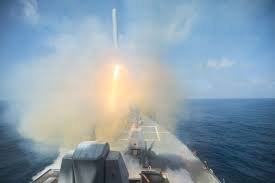
Tomahawk Missiles: A Deep Dive into America’s Long-Range Strike Capability
The Tomahawk cruise missile is a long-range, all-weather, low-flying missile renowned for its precision and versatility. Developed by the United States Navy, it has become a cornerstone of American power projection, utilized in numerous conflicts across the globe. This article provides a comprehensive overview of the Tomahawk, covering its history, capabilities, recent deployments, and future developments.
A History of Precision: From Development to Deployment
The genesis of the Tomahawk dates back to the 1960s, born from a need for a long-range, precision strike weapon. Early iterations focused on anti-ship capabilities, but the missile evolved significantly over the decades. The first operational Tomahawk, the TLAM-C (conventional land-attack missile), entered service in the 1980s. Its initial deployment saw action during Operation El Dorado Canyon in 1986, a strike against Libya. Since then, the Tomahawk has been continuously upgraded, incorporating advancements in navigation, targeting, and stealth technology. A pivotal moment in its history was the widespread use during the Gulf War in 1991, demonstrating its effectiveness against hardened targets.
Key Capabilities and Variants
The Tomahawk isn’t a single missile; it’s a family of missiles with different variants tailored for specific missions. Here’s a breakdown of some key types:
- TLAM-C: The conventional land-attack variant, designed to strike land-based targets.
- TLAM-D: A variant optimized for anti-ship warfare, capable of engaging moving targets at sea.
- TLAM-E: Designed for long-range strike against heavily defended targets.
- Maritime Land Attack Cruise Missile (MLCM): A newer variant with improved capabilities and a focus on maritime targets.
These missiles boast a range exceeding 1,000 miles (1,600 kilometers) and utilize a combination of inertial navigation, GPS, and terrain contour matching (TERCOM) for pinpoint accuracy. Recent upgrades, like the Tomahawk Weapon System Block V, introduce a two-way communication link, allowing operators to alter targets mid-flight and assess battle damage. This capability significantly enhances the missile’s flexibility and responsiveness. The U.S. Navy also continues to explore hypersonic variants to counter emerging threats. You can find more information about the Tomahawk’s evolution at the [Naval Technology website](https://www.naval-technology.com/features/feature-tomahawk-cruise-missile-584174/).
Recent Deployments and Strategic Impact
The Tomahawk has been deployed in numerous conflicts, including operations in Iraq, Afghanistan, Syria, and Yemen. Most recently, Tomahawk missiles were used in retaliatory strikes against Syrian government targets in 2018 following a chemical weapons attack. These deployments underscore the missile’s role as a rapid response option for addressing critical national security interests. The Tomahawk’s ability to strike targets from a safe distance minimizes risk to personnel and allows for precise, targeted strikes, reducing collateral damage. Its strategic impact lies in its ability to project power globally and deter potential adversaries. The Brookings Institution provides insightful analysis on the strategic implications of cruise missile technology: [Brookings – Cruise Missiles](https://www.brookings.edu/research/cruise-missiles/).
The Future of Tomahawk: Upgrades and Challenges
The Tomahawk program isn’t stagnant. Ongoing development focuses on enhancing its capabilities to address evolving threats. The aforementioned Block V upgrade is a prime example, but research is also underway to integrate advanced sensors, improve stealth characteristics, and potentially develop hypersonic variants. However, the Tomahawk also faces challenges. The proliferation of advanced air defense systems poses a growing threat, requiring continuous innovation to maintain its effectiveness. Furthermore, the ethical considerations surrounding the use of autonomous weapons systems are increasingly relevant as the Tomahawk becomes more sophisticated. The Center for Strategic and International Studies (CSIS) offers valuable perspectives on these challenges: [CSIS – Missile Defense](https://www.csis.org/programs/missile-defense-project).