Canadians Navigate Escalating Middle East Conflict
The conflict in the Middle East is intensifying, spreading across multiple fronts. Some Canadians in Bahrain, Lebanon, and Dubai are currently living under bombardment, while others have fled or are considering leaving. The situation is rapidly evolving, leaving many feeling vulnerable and uncertain about the future.

Bahrain Under Fire: A Musician’s Dilemma
Max Proulx, a musician who moved to Bahrain last summer for a work contract, describes his experience as a stark contrast to his previous perceptions of the country as “very safe.” He initially decided to stay with his girlfriend for the Ramadan holidays, a decision he now deeply regrets. “I wish I could turn back time and change that decision,” he laments.
On Saturday, shortly before noon, Proulx heard a loud “boom.” Living 1.5 km from the US base, he immediately understood what was happening. Bombings continued throughout the day, initially every 10 minutes, then becoming more sporadic. He relocated to the capital, Manama, a few kilometers away, hoping for safety. While he no longer feels the vibrations of explosions, he is regularly awakened by sirens and phone alerts – “like an AMBER Alert” – signaling incoming missiles. He even witnessed a drone flying “very close” to his building before a nearby structure was bombed, feeling the blast wave of an interceptor missile pass “practically just above [his] head.”

“If only I could go home,” he says, expressing the sentiment of many stranded Canadians. “I wouldn’t wish this on my worst enemy.” All air activities in Bahrain have been suspended.
Limited Government Assistance
Proulx contacted the Canadian government, receiving a discouraging response: “You should not rely on the Government of Canada for evacuation assistance or assisted departure,” according to a message he shared with La Presse. On Monday morning, the Canadian government released a statement indicating that over 85,000 Canadians and permanent residents are currently in the Middle East, with approximately 3,000 in Iran and 1,500 in Bahrain. The statement confirmed that, as of now, no Canadians have been reported injured or killed due to the hostilities.
However, the government advised Canadians in affected countries to “prepare emergency plans without relying on the Government of Canada for assistance.” They were informed that they would be notified when air or land transportation becomes available, allowing them to make their own decisions.
Lebanon and Beyond: A Region on Edge
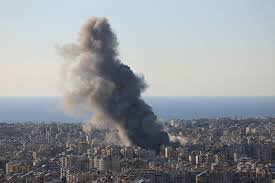
As the conflict enters its third day, both sides remain determined to continue fighting, with Gulf countries threatening retaliation against Iran’s “aggression.” Israel has also expanded operations to Lebanon, launching massive and deadly strikes in response to an attack by Hezbollah in support of Tehran.
Johnny Michael, reached in Hazmieh, Lebanon, feels “safe for now,” but witnesses and hears missiles falling nearby. “We force ourselves to continue our lives normally. Otherwise, we wouldn’t function,” he explains. The 25-year-old student had planned to stay in Lebanon but is now reconsidering, contemplating returning to Europe to finish his studies. “I’m worried about the future of the country. It breaks my heart to see all these people who have to move. It’s really horrible.”

Ghina Mougharbel, a Canadian citizen, is among those who have been forced to flee the bombings. She woke up to the first bombardments in Beirut on Sunday night and waited until morning to evacuate with her two children, aged 12 and 14, to the mountains. Her future is uncertain, with her children’s school closed and no clear timeline for returning home. “We live hour by hour,” she sighs. “It’s very tiring not being able to plan, not knowing what we’ll do tomorrow.”
Other countries have also been affected. In Kuwait, thick black smoke rose above the US embassy and a power plant. In Abu Dhabi, a fire broke out at a fuel storage site targeted by a drone. Cyprus, the EU country closest to the Middle East, saw its British base targeted by three drones launched from Lebanon. Dubai Airport suspended all flights after Iranian missiles and drones were intercepted, disrupting travel plans. Some airlines have begun to gradually resume flights.
Darouny Lao, a Quebecer living in Dubai for four years, was initially concerned but reports that life has returned to normal. “The situation is calm. Authorities have confirmed it’s safe and told us to continue our lives normally.” However, tourists interviewed by the Agence France-Presse (AFP) expressed a desire to leave as soon as possible.
Further Developments:
- Donald Trump warned that a war against Iran could last a month or more.
- OpenAI CEO Sam Altman announced changes to its agreement with the US Department of Defense regarding access to its AI models.
- Israel announced the reopening of a crossing point to Gaza to allow the gradual entry of humanitarian aid.
The situation remains fluid and Canadians in the region are urged to stay informed and prioritize their safety. Stay updated with the latest travel advisories from the Government of Canada.