Poilievre Calls for Emergency Committee to Protect British Columbia Land Rights
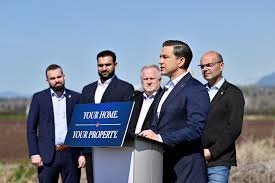
Conservative Leader Pierre Poilievre is intensifying pressure on the federal government to address growing concerns surrounding private land ownership in British Columbia. Speaking in Richmond, B.C., Poilievre demanded an emergency parliamentary committee to study all possible measures to safeguard fee simple title – the most common form of land ownership – across Canada.
This call to action follows the controversial Cowichan decision, a B.C. Supreme Court ruling from August 2025, which established that Aboriginal title takes precedence over fee simple title. The decision has sparked a national debate about the rights of landowners in areas where Aboriginal title has been recognized.
The Cowichan Decision and its Ripple Effects
The Cowichan decision, delivered in Richmond, B.C., recognized the Cowichan Tribes’ Aboriginal title to approximately 300 hectares of developed land. Poilievre criticized the Liberal government for what he perceives as a failure to adequately defend the interests of landowners during the trial. He was flanked by Conservative MPs Aaron Gunn and Ellis Ross during his address.
The precedent set by the Cowichan case has prompted other Indigenous groups in British Columbia to pursue similar land claims. The Dzawada’enuxw First Nation, for example, is currently seeking ownership of private lands, citing the Cowichan decision as a key legal basis.
Federal Response and Proposed Solutions
Poilievre is urging the federal Liberals to publish a comprehensive plan to protect private property ownership within 30 days and to revoke a legal directive that he claims hindered government lawyers from defending fee simple title in court. He firmly believes that property rights are fundamental human rights and that Conservatives will vigorously defend fee simple as the most senior form of land title.
The provincial government and the Cowichan Tribes have jointly stated that they do not intend to invalidate existing fee simple titles and are actively negotiating a reconciliation framework. The federal government, while remaining largely silent on the specifics of the Cowichan decision, has indicated its intention to appeal the ruling. Alec Wilson, a spokesperson for Crown-Indigenous Relations Minister Rebecca Alty, stated that “all options are on the table” regarding the appeal and reaffirmed the government’s commitment to defending fee simple title.
The Appeal Process and Ongoing Uncertainty
Justice Barbara Young’s 863-page ruling established Aboriginal title as a “prior and senior right” to private ownership. All seven parties involved in the Cowichan case – including federal, provincial, and municipal governments, the Vancouver Fraser Port Authority, the Cowichan Tribes, and neighbouring First Nations – have filed appeals. However, the appeals process is currently stalled, awaiting a final order from the judge and the resolution of an application to reopen the trial by a private landowner.
Richmond Mayor Malcolm Brodie emphasized the federal government’s significant role in the case, given its ownership of a substantial portion of the land in question. He urged Ottawa to actively participate in the appeals process and to argue for the extinguishment of Aboriginal title, a position the federal government previously held but abandoned in 2018 under a directive aimed at aligning legal positions with reconciliation efforts.
A Complex Legal Landscape
The 2018 directive, issued during Jody Wilson-Raybould’s tenure as Attorney-General and Justice Minister, prohibits Crown lawyers from taking positions inconsistent with the government’s reconciliation commitments and Section 35 of the Constitution, which protects existing Aboriginal and treaty rights. This shift in legal strategy has become a central point of contention in the debate over land rights in British Columbia.
The situation remains fluid, with the future of land ownership in British Columbia hanging in the balance. The outcome of the appeals process will have far-reaching implications for landowners, Indigenous communities, and the broader legal landscape.
Source: The Globe and Mail