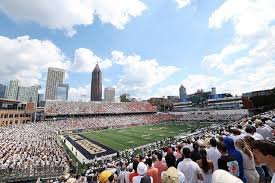
Georgia vs Georgia Tech: Unpacking the Controversial Mercedes-Benz Stadium Move for the Clean, Old-Fashioned Hate
The NCAAF College Football season brings rivalries that ignite passions, and few burn as brightly as the “Clean, Old-Fashioned Hate” between the Georgia Bulldogs and the Georgia Tech Yellow Jackets. For decades, this annual clash has captivated fans, often culminating in dramatic finishes. However, the recent decision to move a pivotal home game for Georgia Tech against its archrival to Mercedes-Benz Stadium sparked considerable debate and introspection.
What should have been a monumental home game at Bobby Dodd Stadium, buzzing with the Yellow Jackets’ revitalized program and fervent fanbase, instead shifted a couple of miles away. While the prospect of a larger venue might seem appealing, it opened the door for the Bulldogs to potentially outnumber their rivals in their own ‘home’ game. This wasn’t merely a logistical change; it was a profound business decision with far-reaching implications for Georgia Tech football.
The $10 Million Question: Why the Shift to Mercedes-Benz Stadium?
The core of the controversy lies in a $10 million deal struck more than a year ago to move the Georgia vs Georgia Tech game. At the time, the decision was seen as a financial necessity, driven by an athletic director who has since moved on. The backdrop included the impending reality of revenue sharing in college athletics, potentially obligating schools to pay substantial sums to athletes.
For institutions like Georgia Tech, operating within the ACC without the immense television deals enjoyed by SEC powerhouses like Georgia, generating new revenue streams became paramount. With historical struggles impacting ticket sales and donations, the offer from Mercedes-Benz Stadium represented a critical influx of funds needed to bolster the athletic program and support initiatives for coaches like Brent Key.
“You could look back and say we wish it was at Bobby Dodd. But I don’t think that the same decision points and opportunities were there,” explained Ryan Alpert, Georgia Tech’s current athletic director. “The facts that they had at the time, and what they were trying to do to put the resources behind (coach) Brent (Key) and the program, that that decision was made and properly made at the time.”
The money, it seems, became a cornerstone in rebuilding the program, allowing the Yellow Jackets to invest in the very elements contributing to their recent upswing in performance.
A Revitalized Program Meets Hard Business Realities
The irony isn’t lost on fans. Since the decision to move the game, Georgia Tech’s program has experienced a remarkable turnaround under Coach Brent Key. After taking Georgia to eight overtimes in their closest contest since 2016 and upsetting then-No. 4 Miami, the Yellow Jackets have infused their fanbase with a renewed sense of optimism. Home attendance has soared, and the program’s trajectory looks more promising than it has in years.
This resurgence, however, made the absence of the Georgia Tech Yellow Jackets from their traditional home turf for such a high-stakes rivalry game even more poignant. While the team’s loss to Pittsburgh somewhat dampened playoff hopes, the emotional weight of giving away a potential packed Bobby Dodd Stadium for the biggest game in decades remained.
Coach Key’s Perspective: Focus on the Field
Coach Key has consistently downplayed the venue, emphasizing his focus on the game itself. “Those are way above my pay grade. I could care less,” Key stated at ACC media days. “We could go play them in Piedmont Park. I’m serious, we’ll go home tonight and play them at 5 o’clock in Piedmont Park. I couldn’t give a crap where we play.” His pragmatic approach highlights a desire to compete regardless of location, a sentiment that resonates with many athletes.
Building a Sustainable Future for Georgia Tech Football
The current athletic leadership, under Ryan Alpert, recognizes the delicate balance between tradition and financial sustainability. The $10 million infusion was a one-time gain, but the goal is to create recurring resources. This includes exploring options like luxury suites and enhancing the overall business model of the athletic department.
A recent example of this forward-thinking approach was the handling of an offer from Mercedes-Benz Stadium for next year’s game against Tennessee. Unlike the past decision, Alpert engaged the fanbase through surveys, gauging their preference for a true home-field advantage at Bobby Dodd. The overwhelming response in favour of keeping the game on campus allowed Georgia Tech to decline a lucrative offer, demonstrating a commitment to fan experience alongside financial prudence.
As Benjamin Utt, a Georgia Tech alumnus and board member, aptly put it: “I love Georgia Tech as an academic school, but it’s a business, too, right? Yeah, you’ve got to survive. And you’ve got to be good. And the money that comes in through athletics helps to do all these unbelievable things we’re doing all around the world.”
The Georgia vs Georgia Tech rivalry will continue to be a marquee event in NCAAF. While the Mercedes-Benz Stadium move sparked debate, it ultimately underscores the complex financial realities facing college athletic programs today. For the Yellow Jackets, it was a move designed to secure resources, rebuild, and forge a path towards sustained competitiveness in an ever-evolving sports landscape.