
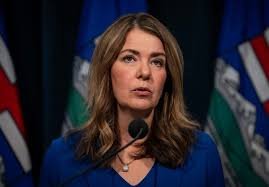
Alberta Premier Seeks Security Clearance from Canada’s Spy Service
Alberta Premier Danielle Smith is taking proactive steps to address potential foreign interference in the province, requesting national-security clearance from the Canadian Security Intelligence Service (CSIS). This move comes as Alberta considers a referendum that could include a question about independence, raising concerns about meddling by external actors.
Concerns Over RCMP and CSIS Transparency
During Question Period in the provincial legislature, Ms. Smith expressed frustration with the lack of information provided by both the Royal Canadian Mounted Police (RCMP) and CSIS regarding security issues surrounding a potential vote on secession. She stated that her government had not received the necessary information, hindering their ability to assess and mitigate potential threats. “I wish we could rely on the RCMP, but they have not been forthcoming on giving us this information,” she explained. “I wish we could rely on CSIS, but they have not been forthcoming at giving us this information because you have to get certain security clearances.”
Foreign Interference and the Independence Referendum
National-security and election experts have voiced concerns about the vulnerability of an independence referendum to foreign interference. Currently, much of the focus is on potential interference originating from the United States. The upcoming vote on immigration and constitutional issues, scheduled for October 19th, is being targeted by separatist groups attempting to gather the required signatures to add a secession question to the ballot.
U.S. Interest in Alberta
The situation is further complicated by statements from U.S. figures, including former President Donald Trump, who has expressed a desire to expand U.S. influence in the Western Hemisphere and even referred to Canada as the “51st state.” There have been multiple meetings between Alberta separatists and the U.S. State Department, and some Trump-aligned officials have publicly supported the idea of a referendum. U.S. Treasury Secretary Scott Bessent even suggested that Alberta should be allowed to join the U.S., citing its potential as a natural partner.
CSIS Response and Investigation Parameters
CSIS spokesperson Lindsay Sloane stated that the agency has recently increased its capacity to share national-security information with provincial governments. However, CSIS investigations are limited to threats to Canada’s security and do not include lawful protest or political advocacy. “CSIS investigates threats to the security of Canada…which would include lawful political advocacy relating to the status of Alberta,” Ms. Sloane clarified. “Any instance where a foreign state might seek to use covert…means to interfere in domestic political processes would be of concern and investigated by CSIS.”
Expert Opinions on Security Clearance
Jody Thomas, former national-security and intelligence advisor to Prime Minister Justin Trudeau, believes Ms. Smith’s request for security clearance is reasonable, especially given recent events like the killing of a Sikh activist in British Columbia linked to the Indian government. Artur Wilczynski, a former federal national-security official, emphasized the need for a “broad-based effort” between governments to address national-security issues ahead of the referendum, stating that close collaboration with CSIS is crucial to mitigate potential threats.
Alberta’s New Intelligence Arm
In response to these concerns, Ms. Smith announced plans to establish an intelligence arm within the Alberta Sheriffs Police Service. This new unit will gather information similar to that collected by other police services, and will be led by Dale McPhee, a former Edmonton Police chief. This development comes as Alberta considers replacing the RCMP with its own provincial police force by 2032.
Learn more about Canada’s security landscape: Royal Canadian Mounted Police and Canadian Security Intelligence Service



