
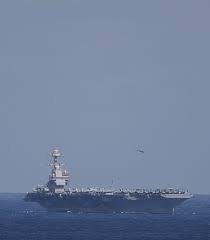
Iran: A Region on Edge – Understanding the Military Landscape
The long-standing and often fraught relationship between the United States and Iran has reached a critical juncture. A significant buildup of U.S. military forces in the Persian Gulf and the Mediterranean Sea signals escalating tensions, raising the alarming prospect of conflict. The stated aim is to pressure Iran regarding its nuclear enrichment program, with President Trump indicating a willingness to authorize military action if a deal isn’t reached. After 47 years of discord, the potential for war between these two nations is disturbingly high.
Mapping the U.S. Military Presence
The United States has effectively surrounded Iran with a substantial military deployment. This strategic positioning underscores the seriousness of the situation and the potential for rapid escalation. The Persian Gulf, once again, finds itself at the center of a potential Middle Eastern conflict, one that could rival the consequences of the 2003 invasion of Iraq.
Key assets deployed include the aircraft carrier USS Abraham Lincoln, three guided-missile destroyers, and the USS Gerald R. Ford, the world’s largest warship. Beyond these recent deployments, the U.S. maintains a significant, permanent military footprint in the region.
- Al Udeid Air Base (Qatar): Home to thousands of U.S. personnel, crucial for past campaigns in Afghanistan and Iraq.
- U.S. Navy’s Fifth Fleet (Bahrain): Patrols over two million square miles of the region.
(Placeholder image – replace with actual map from the original source)
Key Military Installations & Deployments
- Muwaffaq Salti Air Base, Jordan: At least 24 F-15E Strike Eagle fighter jets, four EA-18G Growlers, and five MQ-9 Reaper drones.
- Khalifa Bin Salman Port, Bahrain: Three Littoral Combat Ships.
- Naval Support Activity, Bahrain: Base of the U.S. 5th Fleet.
- Al Dhafra Air Base, UAE: Reconnaissance aircraft and UAVs.
- Al Udeid Air Base, Qatar: The largest U.S. base in the Middle East, also hosting a squadron of RAF Typhoons (British deployment).
Iran’s Missile Capabilities: A Significant Threat
Should conflict erupt, Iran is likely to rely heavily on its ballistic missile arsenal. Its most powerful missiles boast a range of 2,000 kilometers – sufficient to reach European targets. While Iran currently lacks missiles capable of directly striking the continental United States, its regional reach is substantial.
Iran’s shorter-range missiles pose a direct threat to Israel and Qatar, where the U.S. maintains its Al Udeid base. Both nations were targeted during clashes last summer.
(Placeholder image – replace with actual chart from the original source)
Iran’s Military Structure
Iran’s armed forces are divided into two main branches. The Islamic Revolutionary Guard Corps (IRGC) is the more influential, tasked with safeguarding the principles of the 1979 Islamic Revolution. The IRGC oversees Iran’s missile program and commands the Basij militia, used for internal security and suppressing dissent. The IRGC reports directly to Iran’s Supreme Leader, Ayatollah Ali Khamenei.
The loss of former IRGC commander Qassem Soleimani in a 2020 U.S. airstrike remains a significant point of contention.
Sources: Council on Foreign Relations, U.S. Department of Defense, The Globe and Mail



