The $378 Million Victory: Why California Rejected the Billionaire Tax
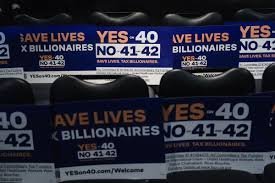
Money, Power, and Politics: The Fall of Proposition 40
In a high-stakes battle over wealth and social funding, California voters have spoken. Proposition 40, a bold proposal designed to levy a wealth tax on the state’s wealthiest residents, was decisively rejected. The measure failed with 52.8% of voters opposing the tax, while 47.2% supported it, according to results confirmed by The Associated Press.
This wasn’t just a vote on fiscal policy; it was a demonstration of the immense financial influence held by the ultra-wealthy. While supporters of the tax fought for a new revenue stream to bolster public services, the opposition launched a massive financial offensive to ensure the measure never saw the light of day.
The Financial Gap: A David vs. Goliath Struggle
The disparity in campaign spending was staggering. The “Yes” campaign, led by the Service Employees International Union-United Healthcare Workers West (SEIU-UHW), managed to raise $33.5 million. While significant, it was a drop in the bucket compared to the war chest of the opposition.
- n
- Total Opponent Spending: Approximately $378.4 million.
- Key Player: Google co-founder Sergey Brin, who donated $102 million to the “Building a Better California” committee.
- The Strategy: Using political committees as passthroughs to fund counter-measures, including Propositions 41 and 42.
A Divided Party: The Democratic Rift
One of the most surprising aspects of the campaign was the internal conflict within the Democratic Party. Rather than a united front, the proposal exposed deep divisions between labor unions and the state’s political leadership.
Governor Gavin Newsom emerged as a prominent critic of Proposition 40. He argued that a one-time wealth tax would be a “reckless experiment” that would drive billionaires out of California, ultimately harming the state’s overall income tax revenue. Newsom even endorsed Proposition 42, a countermeasure specifically designed to ban future wealth taxes in the state.
What was at Stake?
The implications of Proposition 40’s defeat are significant. Supporters claimed the tax would have generated $100 billion to fund critical healthcare and education services. With federal healthcare cuts threatening to leave millions of residents without insurance, labor leaders argue that the state is now in a precarious position.
“That is incredibly corrosive and corrupting to our democracy and our political system,” stated Dave Regan, president of SEIU-UHW, referring to the massive spending by billionaires to kill the measure.
The Bottom Line: Will Wealth Taxes Return?
While the “No” campaign celebrated their victory, the debate over billionaires and their contribution to society is far from over. Despite the defeat of Prop 40, polling suggests a general public desire to tax the ultra-wealthy more heavily. However, with the potential passage of Proposition 42, any future attempts to implement a wealth tax in California may face insurmountable legal hurdles.
As California navigates its fiscal challenges, the question remains: can the state fund its essential services without targeting its richest citizens, or did the influence of money simply outweigh the needs of the many?
📰 You May Also Like