
US Military Buildup in Middle East Amidst Iran Nuclear Talks
Despite ongoing diplomatic efforts to de-escalate tensions with Iran, US President Donald Trump has signaled a potential increase in military presence in the Middle East. This move raises questions about the administration’s strategy and its commitment to a peaceful resolution of the nuclear issue.
Pentagon Prepares for Further Deployment
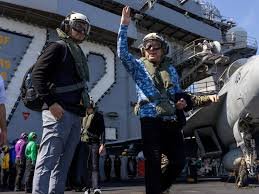
On Thursday, President Trump shared a Wall Street Journal article on his Truth Social platform, titled “Pentagon Prepares Second Aircraft Carrier to Deploy to the Middle East,” without adding any personal commentary. The article detailed how the Pentagon has ordered preparations for a second aircraft carrier strike group to join the USS Abraham Lincoln, already stationed in the region.
According to sources cited by the Associated Press, the world’s largest aircraft carrier, the USS Gerald R. Ford, has been instructed to sail from the Caribbean Sea towards the Middle East. This deployment would place two carrier strike groups in the region, intensifying pressure on Iran to reach an agreement regarding its nuclear program.
Diplomacy and Deterrence: A Balancing Act?
The USS Abraham Lincoln, accompanied by three guided-missile destroyers, arrived in the Middle East over two weeks ago. This buildup coincides with President Trump’s recent meeting with Israeli Prime Minister Benjamin Netanyahu, who has consistently advocated for a more assertive stance against Tehran. Despite this, Trump reiterated his preference for a diplomatic solution.
“There was nothing definitive reached other than I insisted that negotiations with Iran continue to see whether or not a Deal can be consummated,” Trump stated following the meeting. “If it can, I let the Prime Minister know that will be a preference. If it cannot, we will just have to see what the outcome will be.”
Recent Talks and Iranian Concerns
The US and Iran recently held their first round of indirect talks in Oman since last year, with both sides expressing a willingness to continue the diplomatic process. However, no further talks have been publicly scheduled. Tehran has voiced concerns that Israel is attempting to undermine these negotiations.
“Our negotiations are exclusively with the United States – we are not engaged in any talks with Israel,” Iran’s security chief Ali Larijani told Al Jazeera. “However, Israel has inserted itself into this process, with their intent on undermining and sabotaging these negotiations.”
President Trump dismissed claims that Netanyahu was lobbying against talks with Iran, stating, “I’ll talk to them as long as I like, and we’ll see if we can get a deal with them.” He also expressed optimism that an agreement could be reached within the next month, urging Iran to act “quickly.”
Long-Standing Tensions and Potential for Escalation
Trump has consistently stated his goal is to prevent Iran from acquiring nuclear weapons and developing its missile program. However, Iran maintains its nuclear program is for peaceful purposes and has ruled out concessions on its missile arsenal. The possibility of renewed conflict remains a significant concern.
The situation is further complicated by past incidents, including a reported US-backed operation to smuggle approximately 6,000 Starlink satellite-internet kits into Iran following government restrictions on internet access during recent protests. Read more at The Wall Street Journal.
The delicate balance between diplomacy and deterrence will be crucial in navigating the complex geopolitical landscape of the Middle East. The deployment of additional military assets signals a willingness to use force if negotiations fail, but also carries the risk of escalating tensions further.



