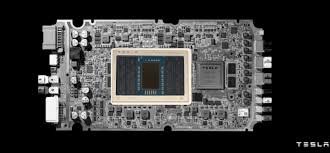
Tesla Stock: AI5 Chip Tape-Out – A Key Milestone for Self-Driving Tech
Tesla CEO Elon Musk recently announced that the company has “taped out” its next-generation AI5 self-driving chip. This is a crucial step in the development process, signifying that the final design has been sent to the foundry for fabrication. However, despite the excitement, volume production is still over a year away.
What Does ‘Tape-Out’ Mean?
In the semiconductor world, “tape-out” marks the point where a chip’s design is finalized and sent to a manufacturing facility (foundry) for production. While a significant achievement, it’s not the end of the road. The chip still needs to be manufactured, rigorously tested, validated, and scaled up for mass production. For automotive-grade AI accelerators like the AI5, this process typically takes 12 to 18 months.
AI5, AI6, and Beyond: Tesla’s AI Roadmap
Musk’s announcement also mentioned AI6 and Dojo3, hinting at Tesla’s ambitious plans for future AI development. Currently, Tesla is reportedly utilizing TSMC for AI5 production, while Samsung’s 2nm line is slated for the follow-up AI6 chip. However, recent reports suggest that AI6 production has been delayed by approximately six months due to yield issues with Samsung’s 2nm technology, potentially pushing mass production to Q4 2027.
A History of Promises and Delays
Tesla initially promised AI5 would be integrated into vehicles nearly two years ago. Musk has previously described AI5 as being up to 10x more powerful than its predecessor, AI4, and envisioned a rapid 9-month design cycle for subsequent generations. This pace is considered exceptionally fast for major semiconductor architectural overhauls.
The introduction of the “AI4.5” computer in late 2023 Model Y vehicles demonstrates the challenges Tesla faces. This interim solution was implemented to provide sufficient computing power for larger FSD neural networks while AI5 development continued.
What This Means for Tesla Investors and Customers
The tape-out of AI5 is a positive sign, indicating progress in Tesla’s self-driving technology. However, it’s important to note that AI5 won’t be widely available in vehicles this year. The upcoming Cybertruck, scheduled for production in Q2 2026, will launch with AI4, the same hardware currently found in other Tesla models.
Tesla requires “several hundred thousand completed AI5 boards” before transitioning production lines, a milestone not expected until mid-2027. AI6 and Dojo3 remain in the design phase.
The Bigger Picture: Compute Power and Sensor Limitations
While increased computing power is crucial for advancing self-driving capabilities, it’s not the sole solution. As Musk himself has acknowledged, even the most powerful AI can’t compensate for insufficient sensor technology. More compute allows for faster processing, but it doesn’t guarantee accurate decision-making if the input data is flawed.
A Pattern of Shifting Goalposts?
A recurring concern is Tesla’s tendency to introduce new chip generations before fully delivering on the promises made with previous hardware. Millions of vehicles have been sold with HW3 and HW4, promising unsupervised self-driving, a goal that remains elusive. The constant introduction of new chips raises questions about whether customers are receiving the full value of the technology they’ve paid for.
The tape-out of AI5 is a step forward, but it also underscores a pattern of shifting priorities and delayed expectations. Investors and customers alike should remain cautiously optimistic, recognizing that the path to full self-driving is complex and subject to ongoing challenges.
Further Reading:
- TSMC – Leading semiconductor foundry
- Samsung Semiconductor – Key player in advanced chip manufacturing
- Electrek – Source for Tesla and EV news