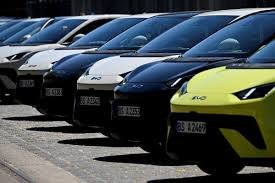
BYD Sets Sights on Canadian Market: Dealership Expansion on the Horizon
Electric car manufacturer BYD Auto Co. Ltd. (BYDDY) is strategically positioning itself to become one of the first Chinese automakers to establish a direct sales presence in Canada, following Prime Minister Mark Carney’s recent decision to allow the import of 49,000 electric vehicles (EVs). This move signals a significant shift in the Canadian automotive landscape.
Dealership Network Development
According to Farid Ahmad, CEO of Dealer Solutions Mergers & Acquisitions in Markham, Ontario, BYD aims to establish a network of 20 dealerships within the next year. The initial focus will be on the Greater Toronto Area, followed by expansion into Vancouver, Montreal, and Calgary. “They’ve asked us to help them find as many of the 20 that they possibly can, but they’re out there doing that themselves, as well,” Ahmad stated. His consultancy is currently in discussions regarding three potential locations for BYD stores.
Competition and Market Dynamics
BYD’s entry into Canada isn’t happening in isolation. China’s Chery Automobile Co. is also preparing to enter the Canadian EV market. This influx of Chinese EV manufacturers is being met with mixed reactions from the domestic auto industry, which views these companies as potential threats due to their often lower prices, cost-effective labour, and, in some instances, state ownership. The competitive landscape is heating up, promising more affordable EV options for Canadian consumers.
BYD’s Global Success
Last year, BYD surpassed Tesla to become the world’s leading seller of electric cars, with 2.26 million battery-only passenger EVs sold, alongside a comparable number of plug-in hybrid electric vehicles. The company’s popularity extends beyond China, with a growing presence in Asia, Europe, Mexico, South America, and Australia. BYD offers a diverse range of EV models, including compact crossovers, sedans, and hatchbacks, consistently receiving positive reviews and competitive pricing.
Trade Agreements and Tariffs
The Canadian government recently agreed to reduce tariffs on Chinese EVs to 6.1 per cent from 100 per cent, in exchange for reduced Chinese duties on Canadian exports like canola, lobsters, crabs, and peas. This agreement is expected to attract Chinese joint-venture investment into the Canadian EV supply chain. The import quota is set to increase to 70,000 vehicles within five years, with over half priced under $35,000.
Government Incentives and Concerns
While Prime Minister Carney has ended the federal EV sales mandate, he has announced substantial investments in charging infrastructure and consumer rebates for EV purchases. However, these subsidies currently do not apply to Chinese EVs, favouring vehicles made in Canada or countries with existing free-trade agreements. This has sparked debate, with some arguing that excluding Chinese EVs limits consumer choice and hinders the adoption of affordable, emission-reducing vehicles. Canada and the United States previously imposed 100% tariffs on Chinese EVs in 2024 to protect domestic manufacturers.
Looking Ahead
BYD’s expansion into Canada represents a significant development in the country’s evolving EV market. The company’s success will depend on its ability to establish a robust dealership network, navigate trade regulations, and compete effectively with established automakers. The coming years will be crucial in determining the long-term impact of Chinese EV manufacturers on the Canadian automotive industry. You can find more information about the evolving EV market at The Globe and Mail.