Beyond the Road: The Rise of the Electric Flying Taxi
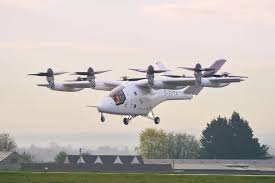
Imagine skipping the gridlock of Toronto or Vancouver traffic by simply lifting off vertically and gliding across the skyline. This vision of the future is moving closer to reality. Recently, the aviation world witnessed a significant milestone at Cotswold Airport in the UK: the Vertical Aerospace VX4 successfully completed its transition flight, marking a pivotal moment for the flying taxi industry.
The Technical Breakthrough: From Drone to Airplane
The VX4 isn’t just another drone; it is an eVTOL (electric Vertical Take-Off and Landing) aircraft. According to Scientific American, the “transition phase”—shifting from a vertical hover to forward wing-borne flight—is one of the most complex engineering challenges in aviation.
How the VX4 achieves this:
- n
- Vertical Lift: Using eight powerful rotors, the aircraft lifts off exactly like a drone.
- The Transition: Four of the front rotors tilt forward, transforming the vehicle from a hover-state (similar to a helicopter) into a sleek, efficient aircraft.
- Safe Descent: To land, the process is reversed, allowing the VX4 to descend vertically onto its landing pad with precision.
David King, Chief Engineer at Vertical Aerospace, emphasizes that this tilt-rotor technology allows a vehicle to go from startup to stable flight in under a minute, proving the viability of the design.
The Road to Commercialization: Safety First
While a successful test flight is an exciting victory, taking a taxi into the clouds for paying passengers requires more than just a working prototype. It requires rigorous certification.
Daniel Pleffken, an expert in aircraft certification from Embry-Riddle Aeronautical University, warns that there is a vast difference between a “successful flight” and a “commercially safe flight.” For the public to trust these vehicles, manufacturers must prove stability under all weather conditions and extreme failure scenarios. Currently, all VX4 flights are under the strict supervision of the UK Civil Aviation Authority (CAA) to ensure every safety protocol is met.
More Than Just a Plane: The Need for an Ecosystem
A flying taxi cannot operate in a vacuum. For this technology to integrate into our cities, a complete urban air mobility ecosystem must be built, including:
- Vertiports: Specialized landing pads integrated with high-speed electric charging stations.
- Air Traffic Management: New rules for low-altitude airspace to prevent collisions.
- Professional Operations: A trained workforce to manage the fleet and ground logistics.
Will We Actually Use Them?
There is also a socioeconomic question: will the average commuter pay for a flying taxi? Professor Laurie Garrow from the Georgia Institute of Technology suggests that eVTOLs face stiff competition from autonomous ground vehicles. If a self-driving car can provide a relaxing, efficient commute, the high cost of flight might be a hard sell for daily trips.
Instead, the first wave of adoption may happen in the tourism sector. We are more likely to see these electric taxis operating in breathtaking locations—such as over the Grand Canyon or the volcanic landscapes of Hawaii—where the experience of the flight is as valuable as the destination.
Conclusion: The Dawn of a New Era
We are currently in the “dawn era” of the flying taxi. While the hardware is evolving rapidly, the infrastructure and regulatory frameworks are still catching up. One thing is certain: the way we perceive the word “taxi” is about to change forever.