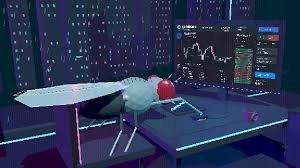
The Intersection of Entomology and Finance: Introducing Stonkfly
In the ever-evolving world of cryptocurrency trading, developers are constantly searching for the “edge”—that secret algorithm or strategy that can predict market movements. However, a recent collaboration between Google, the Howard Hughes Medical Institute, and other researchers has taken a detour from traditional quantitative analysis to explore something far more biological: the neural circuitry of a fly.
Meet Stonkfly, an experimental project that attempts to bridge the gap between biological neural models and automated financial trading. But before you imagine a swarm of flies managing your portfolio, let’s dive into how this fascinating system actually works.
Visual Intelligence: Seeing the Market
Unlike most trading bots that process raw numerical price data, Stonkfly operates on a visual basis. It doesn’t “read” numbers; it “sees” charts. The system converts public price data from Coinbase into 320×180 pixel images.
- n
- Brightness and Color: The model assigns specific brightness levels to visual inputs and uses blue and green hues to represent market trends.
- Comprehensive View: These images encompass historical price movements, trading pairs, and current bid/ask prices.
- Privacy by Design: Notably, the model does not see the account balance or profit/loss, focusing purely on market patterns.
From Nerve Cells to Trade Orders
The core of Stonkfly is a simulated neural circuit derived from a fly’s brain. The decision to execute a trade is based on the “firing” frequency of specific simulated nerve cells.
By mapping the difference in electrical signals between left and right groups of nerve cells, the system triggers one of three actions: Buy, Sell, or Do Nothing. It is important to clarify that this is a conversion mechanism designed by developers—not a discovery of a “trading center” within a real fly’s brain, nor is it driven by a Large Language Model (LLM).
The Dopamine Loop: Reward and Aversion
To facilitate learning, Stonkfly utilizes a simulated feedback mechanism mimicking the brain’s reward system. This is where the biology gets interesting:
- Positive Reinforcement: When the total asset value increases, 15 “dopamine cells” are stimulated, signaling a reward.
- Negative Reinforcement: A decrease in value stimulates 2 cells on the aversive side.
- Holistic Calculation: This system accounts for trading fees and unrealized gains, meaning the model feels the “pressure” of the market even while holding assets.
Real-World Integration and Limitations
Stonkfly isn’t just a theoretical exercise. Using the Coinbase AgentKit, the system can be integrated with Coinbase Advanced to place real spot orders. However, the developers have implemented strict guardrails to ensure safety:
- No High Risk: Short selling and leveraged trading are completely unsupported.
- Controlled Volume: There are strict limits on the amount and number of orders placed.
- Simulation First: By default, the system operates using virtual funds and real-time Bitcoin (BTC) and USDC market data.
Conclusion: Science Experiment or Trading Tool?
While the concept of bio-inspired cryptocurrency trading is captivating, the creators are quick to manage expectations. As of now, Stonkfly is a scientific experiment. There is currently no evidence that this fly-derived model outperforms traditional trading strategies or consistently generates profit.
As the developer nftechie points out, triggering dopamine cells in a model is a far cry from mastering the complexities of global financial markets. Nevertheless, Stonkfly opens a provocative conversation about how biological intelligence can inspire the next generation of AI in finance.