Sony AI Unveils ‘Ace’: The Robot That’s Taking on Elite Table Tennis Players
For years, Artificial Intelligence has dominated the virtual world, conquering complex strategy games like StarCraft II and Chess. However, the physical world—especially high-speed, real-time sports—has remained a daunting frontier. That is, until now. Sony AI has introduced Ace, a groundbreaking autonomous system designed to compete with elite human table tennis players.
Table tennis is one of the fastest sports on the planet. With ball velocities exceeding 20 m/s and spins reaching 1,000 rad/s, the window for reaction is often less than half a second. To master this, Sony didn’t just build a machine; they built a physical AI agent capable of human-level precision and reaction.
The Secret Sauce: How Ace Sees and Thinks
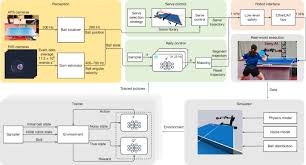
To compete at a professional level, Ace requires a level of perception that traditional cameras simply cannot provide. Sony solved this by integrating cutting-edge sensing technology:
- High-Speed Perception: Ace utilizes nine Sony IMX273 APS cameras for precise 3D ball triangulation at 200 Hz.
- Event-Based Vision: To track the ball’s spin (angular velocity), Ace uses Sony IMX636 event-based vision sensors. Unlike standard cameras, these sensors only record changes in pixels, allowing for incredibly low latency and zero motion blur.
- Deep Reinforcement Learning (RL): Ace’s “brain” was trained entirely in simulation using a Soft Actor-Critic (SAC) algorithm. This allows the robot to learn complex skills—like high top-spin returns—and transfer those skills to the real world with minimal gap.
Engineering Agility: The Hardware
You cannot play professional ping-pong with a clunky industrial arm. Ace features a custom-built platform with eight degrees of freedom, providing the agility needed to cover an Olympic-sized court. To ensure the robot could move fast enough to hit a professional drive shot, the components were 3D-printed using Scalmalloy, a high-strength alloy that reduces mass without sacrificing stiffness.
The Ultimate Test: Robot vs. Human
In a series of matches conducted under the official International Table Tennis Federation (ITTF) rules, Ace was pitted against five elite athletes and two professional league players. The results were staggering:
- Against Elite Players: Ace secured three victories out of five matches, proving it can consistently outperform highly trained athletes.
- Against Professionals: While the pro players took the wins, Ace remained competitive, returning high-speed shots that would baffle most amateur players.
- The “Ace” Serve: Using a genetic algorithm to optimize striking trajectories, the robot was able to perform challenging serves, scoring numerous direct points.
Beyond the Game: Why This Matters
While watching a robot play table tennis is entertaining, the implications of Sony’s research extend far beyond sports. The ability to execute fast, precise, and adversarial interactions in a dynamic environment is the “Holy Grail” of robotics.
The technology powering Ace—specifically the combination of event-based vision and deep RL—could revolutionize several industries:
- Manufacturing: Robots that can react in real-time to shifting parts on a high-speed assembly line.
- Service Robotics: AI agents that can interact safely and fluidly with humans in crowded environments.
- Healthcare: Surgical robots with the precision and reaction speed to handle unexpected physical changes during a procedure.
As detailed in the research published by Nature, Ace represents a paradigm shift. We are moving from AI that can think to AI that can act at the very edge of human capability.
Conclusion
Sony AI has proven that the gap between simulated intelligence and physical mastery is closing. Ace isn’t just a ping-pong player; it’s a blueprint for the next generation of agile, intelligent machines. Whether in a stadium or a factory, the era of high-speed physical AI has officially arrived.