
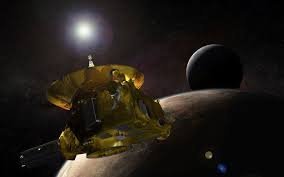
NASA’s New Horizons Mission: Unlocking the Secrets of the Kuiper Belt
Imagine waking up after your longest sleep ever, only to realize you are 5.9 billion miles (9.5 billion kilometers) away from home. This is exactly what happened to NASA’s New Horizons spacecraft, a marvel of engineering that continues to push the boundaries of human knowledge at the very edge of our solar system.
After entering a planned hibernation mode on August 7, 2025, the spacecraft successfully awakened on June 23, triggered by precise commands stored in its onboard computer. Flight controllers at the Johns Hopkins University Applied Physics Laboratory have confirmed that the probe is in excellent health and is now transmitting a treasure trove of scientific data gathered from the icy reaches of the Kuiper Belt.
What is the Kuiper Belt?
For those unfamiliar, the Kuiper Belt is a vast region of frozen, rocky bodies known as trans-Neptunian objects (TNOs). These objects are essentially primordial remnants from the formation of our solar system about 4.5 billion years ago. While Pluto is the most famous resident of this region, it is just one of thousands of icy worlds waiting to be explored.
Beyond Pluto: What New Horizons is Discovering
While the world remembers New Horizons for its historic 2015 flyby of Pluto and its 2019 encounter with the “snowman-shaped” object Arrokoth, the mission is far from over. The spacecraft is currently uncovering revelations that challenge our understanding of planetary birth.
According to project scientist Pontus Brandt, the mission is focusing on several key areas:
- n
- The Architecture of Planetesimals: New Horizons is finding more “paired” or binary bodies like Arrokoth than previously expected, suggesting that this may be the primary way larger planets are built in various stellar systems.
- The Heliosphere’s Shield: By measuring the distribution of gas in the outer heliosphere, the probe is helping scientists understand how the “solar bubble” protects Earth from 70% of dangerous galactic cosmic rays.
- The Dust Mystery: The Venetia Burney Student Dust Counter has provided a surprising curveball: the environment remains dusty even beyond the known boundary of the Kuiper Belt.
“I have a hunch that we have just scratched the surface of what the entire solar system really looks like,” says Brandt, hinting that hundreds of unexplored dwarf planets may still be lurking in the dark.
The Secret to Longevity: Space Hibernation
How does a spacecraft survive for nearly two decades in the freezing vacuum of space? The answer is hibernation. Since its launch in January 2006, New Horizons has slept more than 20 times to conserve power and resources.
During these periods, the craft remains in a stable, low-power mode, while the flight computer monitors its vitals and sends a weekly “all-clear” beacon back to Earth. This strategic resting allows the mission to extend its lifespan far beyond original expectations.
The Road to Interstellar Space
The current phase of the New Horizons Kuiper Belt mission is officially slated to conclude in 2029. However, if the spacecraft remains healthy, the journey could continue. Following the legendary path of the Voyager probes, New Horizons is on a trajectory that will eventually lead it outside the heliosphere and into the mysterious void of interstellar space.
As we look forward to the launch of the Nancy Grace Roman Space Telescope, the data sent back by New Horizons serves as a vital map, guiding us toward a deeper understanding of our cosmic neighborhood.



