Meta’s Compute Explosion: Is the Social Media Giant Becoming the New AI Cloud Powerhouse?
Recent headlines have sparked a heated debate in the tech world: Is Meta transforming into a “Neocloud”? While some market analysts suggest a potential “overcapacity” crisis, leading to aggressive sell-offs of specialized providers like Coreweave and Nebius, the reality on the ground tells a very different story.
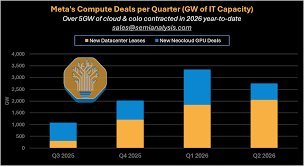
Far from slowing down, Meta is accelerating its datacenter and compute procurement at a breathtaking pace. We are witnessing a strategic pivot where compute isn’t just a tool—it’s the core engine of Meta’s future economy. With Capex projections for 2027 looking shockingly high, Meta has already contracted over 5GW of capacity across cloud and colocation services in just the first half of the year.
The Scale of Ambition: Beyond the Headlines
There is a common misconception that US datacenter growth is stalling. However, a quick look at Meta’s two largest campuses reveals that just these two sites represent 2.5GW of capacity under construction. To put this in perspective, Meta is deploying infrastructure faster than many smaller cloud providers can imagine, utilizing innovative “tent” designs for ultra-fast deployment across the US.
Four High-Value Pillars of Meta’s Compute Strategy
The big question is: What will Meta actually do with all this power? Rather than becoming a low-margin bare-metal provider, Meta is focusing on four high-margin, high-value use cases:
- Frontier AI Models: Meta remains laser-focused on training world-class models through its Superintelligence Labs, aiming to close the gap with rivals like Anthropic and OpenAI.
- Advanced RecSys (Recommendation Systems): Meta is scaling its ad recommendation systems by over 10x in complexity. This allows for smarter, generative targeted ads that drive massive revenue growth and better ROAS for advertisers.
- Token-as-a-Service: Similar to AWS Bedrock or Google Vertex, Meta is exploring a “Bedrock-type” model. Reports suggest final talks with Anthropic to offer private instances of Claude, potentially creating a premier Sales & Marketing SaaS powered by Frontier AI agents.
- The “SpaceX-style” Compute Model: Taking a page from Elon Musk’s playbook, Meta is eyeing the high-premium, on-demand compute market. By offering large-scale compute with short-term flexibility, Meta could generate billions in revenue from just a few hundred megawatts.
Why This is a “CFO’s Dream”
Traditional IaaS (Infrastructure as a Service) vendors often struggle with gross margins around 30%. Meta, however, is avoiding this trap. By diversifying its compute utility—shifting between internal AI training, ad optimization, and high-premium external rentals—they have created a safety net of profitability.
If the quest for Superintelligence hits a plateau, Meta can simply pivot that capacity toward their high-margin “SpaceX-style” deals or their RecSys engine. This flexibility makes the massive investment in GPU infrastructure a calculated, low-risk bet on the future of intelligence.
The Competitive Edge: Meta vs. The Hyperscalers
While Oracle has struggled to monetize its gigawatts of compute effectively, Meta is positioned to capitalize on the market gap. By combining a massive distribution network (Facebook, Instagram, WhatsApp) with a vertically integrated stack—from CPUs to GPUs—Meta isn’t just building a cloud; they are building an AI ecosystem.
The bottom line: Meta isn’t just playing catch-up in the AI race; they are redesigning the track. Whether through internal breakthroughs or strategic partnerships, the sheer volume of their compute expansion ensures they will be a dominant force in the next era of the AI cloud.