
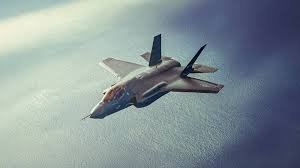
The Stealth Paradox: Inside the Lockheed Martin F-35 Lightning II
In the high-stakes world of aerial combat, invisibility is the ultimate advantage. The Lockheed Martin F-35 Lightning II is the pinnacle of this philosophy, engineered as a stealth fighter designed to penetrate the most sophisticated air defence systems. However, this invisibility comes with a significant engineering trade-off: the need to carry munitions internally.
To maintain its low radar cross-section, the F-35 must hide its missiles and fuel tanks inside internal bays. Carrying weapons externally would essentially turn the aircraft into a “bright light” on enemy radar, sacrificing its primary survival mechanism. This design choice, made in the early 2000s, continues to dictate the evolution of modern weaponry today.
The AIM-260 JATM: Engineering for the Gap
Because the F-35’s internal bays are relatively shallow, not every missile fits. This limitation gave birth to the AIM-260 Joint Advanced Tactical Missile (JATM). Specifically designed to slide into the F-35’s constraints, the AIM-260 is a game-changer in the air-to-air arena.
Unlike its predecessor, the AIM-120 AMRAAM, the AIM-260 is optimized for maximum speed and range, stripping away mid-body control surfaces to achieve a sleeker profile. This is a direct response to the increasing capabilities of adversaries, such as China’s PL-15 missile, ensuring that the US and its allies maintain a dominant “no-escape zone” in the sky.
‘Beast Mode’ vs. Stealth: A Strategic Choice
While stealth is the priority, the F-35 possesses a hidden side known as “Beast Mode.” In this configuration, the aircraft carries a massive external payload—up to 22,000 lbs of munitions—bringing its total capacity to a staggering 27,700 lbs.
However, Beast Mode is rarely used in contested airspace because it eliminates the aircraft’s stealth advantage. Instead, the F-35 often operates as an “assassin,” relying on its sensors to coordinate attacks, while 4.5-generation fighters like the F-15EX Eagle II—often dubbed the “thug”—act as the heavy-hitting missile trucks.
Comparing the Internal Bays
The physical constraints of the F-35 vary slightly depending on the variant. Here is how the internal dimensions break down:
- F-35A & F-35C: Approximately 14 feet long, 25 inches wide, and 25 inches deep.
- F-35B (STOVL): Slightly shorter, measuring between 12.5 to 13 feet in length, with a width of around 24 inches.
A Global Arms Race of Innovation
The F-35 is not alone in the stealth race. Russia’s Su-57 and China’s J-20 also utilize internal bays. Even upcoming projects, such as the Anglo-Japanese-Italian GCAP/Tempest, are aiming for larger internal volumes to carry more diverse weaponry without compromising stealth.
The evolution of the Lockheed Martin F-35 Lightning II highlights a fascinating reality of military aviation: engineering decisions made two decades ago are still shaping the missiles of tomorrow. As the US Air Force and Navy continue to integrate advanced weaponry like the MBDA Meteor and the AIM-260, the F-35 will remain the cornerstone of air superiority well into the 2060s.



