Gen X and the Glory of Analog Cars: Why Modern Rides Just Don’t Compare
Growing up, many of us heard our elders mutter the phrase, “they don’t make ’em like they used to,” usually while gesturing toward a rusted but sturdy vintage sedan. At the time, it felt like a cliché. Fast forward to today, and the irony has come full circle. As a member of Gen X, I find myself uttering those exact words, specifically when talking about the automotive landscape.
For those unfamiliar, Gen X encompasses those born between 1965 and 1980. We are the “Latchkey Generation,” defined by a blend of independence, resourcefulness, and a healthy dose of cynicism. According to Encyclopedia Britannica, these traits shaped our identity. This same spirit extends to our love for cars—machines that were loud, inefficient, and visceral, unlike today’s sanitized “transit pods” filled with digital distractions and electronic nannies.
The Thrill of the Analog Experience
Modern cars are marvels of engineering, but they often lack soul. Today’s vehicles are heavy, computerized, and designed to do the driving for you. For Gen X, the appeal lies in the connection between the driver and the machine. Here are five legendary cars that encapsulate the raw energy of the era—and why younger generations might struggle to “get” them.
1. The Volkswagen GTI Mk1 (1983)
While the modern GTI is a powerhouse—frequently appearing on Car and Driver’s 10 Best lists—the original Mk1 is the true icon. Why? Engagement.
- Weight: The Mk1 weighed around 2,100 lbs, compared to the modern version’s 3,300+ lbs.
- Feel: With 14-inch tires and a manual gearbox, it offered a level of “tossability” that modern, heavy hatches simply cannot replicate.
- The Draw: It wasn’t about the horsepower; it was about feeling every vibration of the road.
2. The Jeep Cherokee XJ
The modern Cherokee is a smooth, unibody crossover. The XJ, however, was a rugged beast. Built with a body-on-frame construction, it provided actual off-road capability and a ride that reminded you exactly where you were.
Beyond the mechanics, the XJ holds a cultural trophy: it was the anti-hero car in the 1985 cult classic “The Goonies.” With manual window cranks and a bulletproof straight-6 engine, it represented an era of automotive simplicity where you could actually fix your own car with a basic set of wrenches.
3. The Merkur XR4Ti
If you’ve never heard of the Merkur XR4Ti, you aren’t alone. This quirky, European-inspired sports sedan was a bold experiment by Ford in the 80s. With its distinctive biplane rear spoiler and a turbocharged inline-4, it was an oddity that commanded attention.
Tuned with input from racing legend Jackie Stewart, the XR4Ti was surprisingly fast—outpacing some Ferraris of its time. It was a “boondoggle” of a car, but for Gen X, that weirdness is exactly what made it cool.
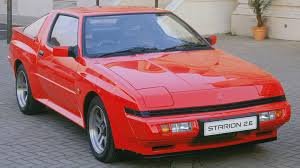
4. The Mitsubishi Starion & Chrysler Conquest
Before the era of ubiquitous crossovers, the “Starquest” twins defined 80s futuristic style. These cars were a symphony of:
pop-up headlights, boxed fender flares, and hammer-like turbo boost.
While a Millennial might mistake a Starion for a DeLorean, Gen Xers remember it as a symbol of an era when Mitsubishi and Chrysler were daring enough to build wickedly cool, rear-wheel-drive coupes that felt like they belonged in a synth-wave music video.
5. The Ford Crown Victoria (1992-2008)
The Crown Vic is the definition of “bulletproof.” A rear-wheel-drive, V8-powered full-size sedan, it served as the backbone of American police fleets for decades. Its headlight signature still strikes a chord of authority (and slight anxiety) in drivers everywhere.
In a world of plastic SUVs, the Crown Vic offered a cushy front bench seat and an engine that was cheap and easy to maintain. It wasn’t fuel-efficient, but it was an absolute tank—a final stand for the classic American sedan before the crossover onslaught.
Final Thoughts: Why It Matters
The gap between Gen X and Gen Z isn’t just about technology; it’s about the experience of control. We miss the days when driving required critical thought, manual effort, and a bit of bravery. While we appreciate the safety and efficiency of modern cars, there will always be a place in our hearts for the loud, leaky, and legendary machines that defined our youth.
Because if you know, you know.