
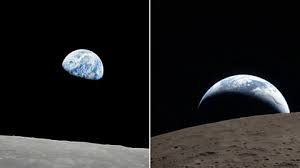
From Earthrise to Earthset: How the Moon Mirrors Our Changing Planet
For decades, the Moon has served as more than just a destination for exploration; it has been a mirror reflecting the fragility and beauty of our own home. In 1968, a single photograph changed the way humanity viewed its place in the cosmos. Fast forward to 2026, and a new image is telling a different, more urgent story.
The Legacy of Earthrise: A Wake-Up Call from 1968
When the crew of Apollo 8 first orbited the Moon, they were met with a desolate, monochromatic wasteland. Frank Borman, the mission commander, described the lunar surface as a “distressed” landscape of grey, black, and white, devoid of any color.
However, as they completed their fourth orbit, a breathtaking sight emerged from the lunar horizon: the Earth. The resulting photo, known as “Earthrise,” captured our vibrant blue planet suspended in the vast, dark oblivion of space. It was a moment of profound realization—that the only splash of color in the entire universe they had seen was home.
This image did more than capture a moment; it ignited a global movement. By framing the Earth as a lonely, fragile marble, it galvanized the early environmental movement and led directly to the creation of the first Earth Day in 1970.
Artemis II and the Arrival of “Earthset”
Fifty-eight years later, history has repeated itself with a modern twist. During a recent fly-by of the Moon, the Artemis II crew captured a striking new image: “Earthset.”
Unlike the accidental nature of the original Earthrise, NASA went into the Artemis mission with a clear objective. As Lori Glaze of NASA’s Exploration Systems Development Mission Directorate noted, the agency was determined to capture the Earth dipping below the barren lunar landscape once again. Captured through the window of the Orion spacecraft, the image reveals the sunlit Oceania region, brilliant white clouds, and deep blue waters, contrasted against the overlapping craters of the Moon.
A Tale of Two Photos: What Has Changed?
While a few decades may seem insignificant in geological time, the difference between Earthrise and Earthset is a stark reminder of the anthropocene. Climate scientists point out that the Earth captured in 2026 is fundamentally different from the one seen in 1968.
- n
- Atmospheric Shifts: Carbon dioxide levels have risen by approximately one-third since the Apollo 8 mission.
- Temperature Rise: Global temperatures have climbed by at least 1°C, altering weather patterns and ecosystems.
- The Cryosphere in Crisis: Glaciologists note that 28,000km of ice shelves have collapsed in Antarctica between the two photos, a change unprecedented in the last 10,000 years.
- Landscape Transformation: From the shrinking of the Aral Sea to the expansion of concrete jungles, the “texture” of our land has been permanently altered by human activity.
Why Human Perspective Still Matters in the Age of AI
In 2026, we have thousands of satellites providing a constant stream of data from the European Space Agency (ESA) and NASA. We have ultraviolet feeds and real-time video from the ISS. So, why does a human-taken photo from the Moon still matter?
According to Craig Donlon of the ESA, the human element adds emotion and intent. A satellite captures data; an astronaut captures a feeling. The choice of framing and focus reflects a conscious realization: “That’s where we live, that’s it, that’s everything.”
Final Thoughts: A Call to Action
The journey to the Moon has always been about discovery, but perhaps the greatest discovery is the realization of how precious our home is. From the inspiration of Earthrise to the warning of Earthset, the Moon continues to remind us that while we may reach for the stars, our survival depends on how we treat the small, blue planet we left behind.



