
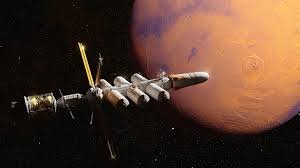
Revolutionizing the Journey to Mars: A New Shortcut Through the Stars
For decades, the dream of stepping foot on Mars has been tempered by a harsh reality: the staggering distance and the complex orbital mechanics of our solar system. Currently, a round trip to the Red Planet is a grueling commitment, often stretching to nearly three years due to the need for fuel-efficient planetary alignments that only occur every 26 months.
However, a groundbreaking study published in the journal Acta Astronautica suggests that the secret to faster interplanetary travel might be hidden in plain sight—specifically, in the early, imprecise data of near-Earth asteroids.
The Asteroid Connection: An Unexpected Clue
Cosmologist Marcelo de Oliveira Souza, from the State University of Northern Rio de Janeiro, stumbled upon a fascinating possibility while studying asteroid 2001 CA21. While astronomers usually discard early orbital estimates in favour of more precise data, Souza realized these initial trajectories could reveal “ultra-short” geometric routes between Earth and Mars.
By analyzing the geometry of the October 2020 opposition—when Earth and Mars were at their closest—Souza found that a theoretical trip could take as little as 34 days. While such a speed would be impossible with current landing technology, it opened the door to calculating more viable, high-speed windows for future missions.
The 2031 Window: A Game-Changer for Exploration
Using a method known as Lambert analysis, the research identified a specific golden window in 2031 that could radically change human spaceflight. According to the study, a mission launched during this alignment could potentially complete a full round trip in just 153 days (approximately five months).
The proposed 2031 itinerary looks like this:
- n
- Departure: Earth on April 20, 2031.
- Arrival at Mars: May 23 (a 33-day journey).
- Surface Stay: Approximately 30 days of exploration.
- Return Departure: June 22.
- Earth Arrival: September 20 (a 90-day return leg).
Overcoming the Speed Barrier
The primary challenge for these “rapid transfers” is velocity. To achieve these timelines, spacecraft would need departure speeds far beyond our current standard missions. However, this isn’t entirely science fiction. The NASA New Horizons probe, for example, was launched at 16.26 km/s, making it one of the fastest human-made objects ever sent into space.
With the development of next-generation propulsion systems and massive launch vehicles like SpaceX’s Starship or Blue Origin’s New Glenn, these high-velocity trajectories may move from the realm of theory to reality.
Why This Matters for Humanity
Reducing the time astronauts spend in deep space is not just about convenience; it is a matter of safety. Shorter trips mean:
- Reduced Radiation Exposure: Less time spent outside Earth’s protective magnetic field.
- Psychological Well-being: Shorter isolation periods for crew members.
- Resource Efficiency: Lower requirements for food, water, and oxygen supplies.
While the concept remains theoretical and depends heavily on future spacecraft design, this research provides a vital map for narrowing down the most efficient paths to the Red Planet, bringing us one step closer to becoming a multi-planetary species.



