
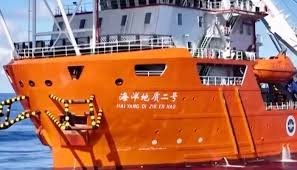
China has demonstrated a significant leap in underwater technology with the successful testing of an advanced deep-sea cable cutter. This development, described as bridging the gap between research and practical application, signals a potential shift in the landscape of submarine infrastructure and underwater operations. The trial, conducted by the “Haiyang Dizhi 2” research vessel, marks the completion of its initial deep-sea scientific mission for 2026, as reported by the Ministry of Natural Resources.
The ‘Last Mile’ Achieved: From Development to Deployment
According to China Science Daily, the sea trial successfully connected the final stages of deep-sea equipment development with real-world engineering applications. This suggests that the technology is now ready for deployment, raising questions about its intended use and potential impact. The ability to precisely cut underwater structures, particularly submarine cables, at depths of thousands of meters represents a considerable technological achievement.
Electro-Hydrostatic Actuator: The Key to Precision and Efficiency
At the heart of this innovation lies an electro-hydrostatic actuator (EHA). This compact device integrates the hydraulic system, electric motor, and control unit into a single, streamlined unit. Unlike traditional systems that rely on external oil piping, the EHA offers a more efficient and precise solution. This design eliminates potential leak points and simplifies maintenance, making it ideal for the harsh conditions of the deep sea. The EHA technology is a critical component, enabling the cutter to function reliably and effectively at extreme depths and pressures.
Implications for Submarine Infrastructure and Security
The development of this deep-sea cable cutter has significant implications for the security and maintenance of the vast network of submarine cables that underpin global communications and data transfer. These cables are vital for international commerce, internet connectivity, and national security. While the technology could be used for legitimate purposes, such as cable repair and decommissioning, its potential for disruption raises concerns. According to the Submarine Cable Systems website, over 99% of international data is transmitted via these underwater cables, highlighting their critical importance. Understanding the capabilities of nations like China in this domain is crucial for maintaining a secure and resilient global network.
China’s Growing Underwater Capabilities
This advancement is part of a broader trend of increasing investment in underwater technology by China. The nation is actively developing a range of deep-sea equipment, including remotely operated vehicles (ROVs), autonomous underwater vehicles (AUVs), and advanced sensors. This focus on underwater capabilities reflects China’s strategic interests in resource exploration, maritime security, and scientific research. Further information on China’s marine technology development can be found at Brookings Institution – China.



