The Race for the Next Generation of Nuclear Power: Canada Takes the Lead
While many nations are still sketching blueprints for the future of energy, Canada is already pouring the concrete. In a significant shift toward sustainable, high-capacity power, the nuclear reactor landscape is evolving, and Canada is positioning itself as the global frontrunner in Small Modular Reactors (SMRs).
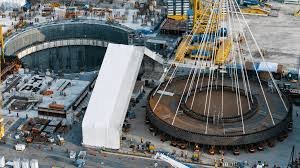
At the Darlington nuclear site, east of Toronto, Ontario Power Generation (OPG) recently achieved a symbolic and technical milestone. The installation of a massive 953-tonne foundation slab—roughly the weight of a fully loaded Airbus A380—into a 35-metre deep shaft marks the concrete beginning of the BWRX-300 construction.
What exactly is the BWRX-300?
Developed by the American-Japanese powerhouse GE Vernova Hitachi, the BWRX-300 is not your grandfather’s nuclear plant. It is a compact, efficient reactor with a capacity of 300 MW. To put that in perspective, a single unit can power over 300,000 homes.
But Canada isn’t stopping at one. The ambition at Darlington is far larger: four units are planned, aiming for a total capacity of 1,200 MW. This project is being watched closely by energy experts worldwide because it represents a gamble on a new industrial model.
The SMR Promise: Standardization vs. Scale
For decades, the nuclear industry relied on “economies of scale”—the bigger the reactor, the cheaper the electricity per megawatt. SMRs flip this logic on its head. The goal is to create standardized, factory-built reactors that can be mass-produced, drastically reducing construction times and financial risks.
- n
- Simplified Safety: The BWRX-300 utilizes modernized boiling water technology, relying more on natural water circulation to reduce dependence on active mechanical systems.
- Lower Entry Barriers: Smaller footprints make them ideal for regions where massive plants are impractical.
- Economic Impact: The project, estimated at $20.9 billion CAD, is expected to generate thousands of jobs during construction and provide stable employment for decades.
Canada vs. The World: A Contrast in Pace
The contrast between Canada and other G7 nations is stark. While the Canadian Nuclear Safety Commission (CNSC) has already granted construction authorization for the BWRX-300, other European powers are still in the design phase.
In France, for instance, EDF is developing the Nuward project. However, after several strategic pivots in 2024 to simplify the design, France remains in the regulatory and conceptual stages. Meanwhile, the US has seen setbacks, such as the 2023 cancellation of the NuScale project in Utah due to skyrocketing costs, fueling skepticism about the economic viability of mini-reactors.
Beyond the Power Grid: The Future of SMRs
The potential of the modern nuclear reactor extends far beyond simply lighting up homes. Industry experts and governments are now eyeing SMRs for highly specialized industrial applications, including:
- Data Centres: Providing constant, carbon-free baseload power for AI and cloud computing.
- Hydrogen Production: Using high-temperature steam to produce green hydrogen.
- Urban Heating: Powering district heating networks for entire cities.
As the International Atomic Energy Agency (IAEA) continues to monitor the global transition to net-zero, the Darlington project stands as the ultimate test. If Canada can prove that SMRs can be built on time and on budget, it won’t just be powering Ontario—it will be exporting the blueprint for the world’s energy transition.