Artemis II Crew Earthset: Why Does Earth Look Different From Space?
Recent images of Earth captured by the Artemis II spacecraft during its lunar flyby have ignited a debate online. Some social media users expressed concern that the more muted colors in the new photos, compared to those taken during the 1972 Apollo 17 mission, indicated a decline in the planet’s health. Claims suggesting rising global temperatures, biodiversity loss, and environmental stress were responsible for the change quickly went viral. However, NASA scientists have debunked these assertions, explaining the differences stem from advancements in camera technology and variations in lighting conditions.
The Viral Comparison: Apollo 17 vs. Artemis II
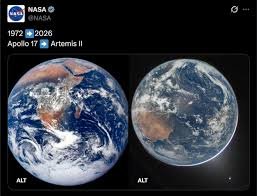
NASA shared a side-by-side comparison of Earth images from the Apollo 17 mission (1972) and the Artemis II mission on X (formerly Twitter) with the caption: “1972 ➡️ 2026 Apollo 17 ➡️ Artemis II.” The contrast was immediately noticeable. The 2026 Artemis II image presented a more subdued palette – grayer blues and less crisp whites – than its 1972 counterpart. This led one user to comment that the visible shifts in cloud patterns, ocean coloration, and land degradation reflected a deteriorating planet.
NASA’s Explanation: It’s About the Technology, Not Climate Change
Fortunately, many astute observers quickly pointed out the likely cause: differences in camera quality and lighting. NASA spokesperson Lauren Low confirmed this, explaining to PolitiFact that the Artemis II photo was taken at night, illuminated only by moonlight, while the Apollo 17 image was captured in direct sunlight. Furthermore, the images underwent different processing techniques.
“The color difference in these images is not caused by climate change,” Low stated in an email. NASA actively utilizes data collected from space to monitor climate change indicators like land and ice coverage, but these specific color variations are unrelated.
The Role of Film vs. Digital Photography
The shift from film to digital photography plays a significant role. The Apollo 17 mission utilized film cameras, known for their tendency to boost saturation and contrast, resulting in more vibrant images straight out of the camera. As Alabama-based photographer Matt Kendall explained, “Film – especially what was used during the Apollo missions – naturally boosts saturation and contrast, which makes images appear more vibrant right out of the camera. It also has a different response to light, often emphasizing blues and warm tones in a way that feels more ‘punchy.’”
Modern digital cameras, on the other hand, prioritize color accuracy and a less stylized aesthetic, often producing images that appear less vivid initially. You can learn more about the differences between film and digital photography at Adorama.
Understanding Earthset and the Artemis II Mission
The “Earthset” – the moment Earth appears to set below the lunar horizon – is a breathtaking sight for astronauts. The Artemis II mission, scheduled for 2025, will be the first crewed mission to the Moon in over 50 years, paving the way for future lunar exploration. You can find more information about the Artemis program on the NASA website.
While the altered appearance of Earth in the new photos may have initially sparked concern, it’s a testament to the evolution of imaging technology and a reminder that appearances can be deceiving. The health of our planet remains a critical issue, but these images aren’t evidence of its decline – they’re a fascinating comparison of how we see our world through different lenses.