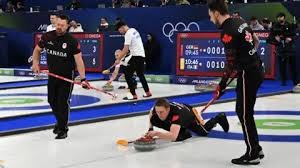
Winter Olympics Curling Cheating Scandal: A Crack in Canada’s Polite Persona
The Winter Olympics have been marred by controversy as accusations of cheating in curling have thrown Canadian teams into the spotlight and sparked a national debate. What began as a dispute over technique has quickly escalated into a full-blown scandal, raising questions about sportsmanship and fair play.
The Accusations: Double-Touching and Heated Exchanges
The controversy ignited on Friday when Swedish player Oskar Eriksson accused Canadian curler Marc Kennedy of “double-touching” – illegally touching the stone a second time after its initial release. A video quickly surfaced, appearing to show Kennedy subtly pushing the stone with his finger. The ensuing exchange between Kennedy and Eriksson was fraught with expletives and quickly went viral.
The following day, the accusations extended to the Canadian women’s team, with captain Rachel Homan also accused of the same infraction during a match against Switzerland. Both Kennedy and Homan vehemently denied the allegations, but the damage to Canada’s reputation in a sport they historically dominate was already done.
National Reaction: Disappointment and a Question of Integrity
The scandal has resonated deeply with Canadians, known for their emphasis on sportsmanship and “niceness.” Fans and commentators alike have expressed disappointment and questioned whether the team’s actions aligned with the spirit of curling.
“It’s a sad day for Canadian sport,” remarked Tim Gray from Alberta. “Integrity in the sport is important, even if you have to call it on yourself.” Others echoed this sentiment, emphasizing the importance of fair play and ethical conduct. As one observer noted, without sportsmanship, it ceases to be sport.
A Nuanced Perspective: Generating Interest and the Impact of Influence
However, some have suggested a more nuanced perspective. Curling instructor Ankara Leonard believes the publicity, while negative, could ultimately benefit the sport by generating increased interest. She also acknowledged that while the alleged infraction likely had minimal impact on the stone’s trajectory, adherence to the rules remains paramount.
Furthermore, Olympic columnist and former curler Tomi Rantamaki highlighted Canada’s significant influence on the sport globally. “Young players in Finland, Korea, Italy, Sweden – everywhere – often copy what Canadian teams do,” he wrote in The Curling News. “And they copy the behaviour.” This underscores the responsibility Canadian athletes have to uphold the highest standards of integrity.
World Curling’s Response and Clarification
In response to the escalating controversy, World Curling clarified its rules regarding double-touching, stating that any contact with the stone during its forward motion will result in its removal from play. While the organization does not currently utilize video review, they deployed additional officials to monitor stone releases in subsequent games.
Beyond Canada: Accusations Spread
The accusations weren’t limited to Canadian teams. Great Britain’s men’s team also faced similar allegations, with Bobby Lammie’s stone being removed from play. Rachel Homan strongly protested the officials’ decision to remove her stone during the loss to Switzerland, calling it “insane.”
The Bigger Picture: A Call for Sportsmanship
The scandal has sparked a broader conversation about the pressures of competition and the importance of maintaining integrity in sports. As one opinion piece in the Globe and Mail argued, Canadian teams need to prioritize their national reputation over the desire to win at all costs. The incident serves as a stark reminder that true victory lies not just in the score, but in the manner in which it is achieved.
Source: BBC Sport