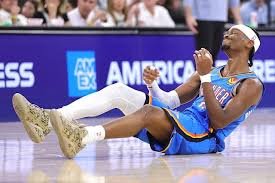
The Controversy of the Crash: Genius or Flopping?
In the high-stakes environment of the Western Conference finals, a single whistle can change the momentum of a game. For Shai Gilgeous-Alexander, the star guard of the Oklahoma City Thunder, the difference between a missed shot and two free throws often comes down to one thing: hitting the hardwood.
Consider two nearly identical plays. In the first, SGA takes a stepback jumper, makes contact with the defender, and falls to the floor. The result? A whistle and two free throws. In the second, the movement is the same, the contact is similar, but SGA lands on his feet. The result? No call. No points.
This discrepancy has ignited a firestorm on social media, with fans and critics labeling the OKC star a “flopper.” However, if you look past the aesthetics, you’ll find a calculated, mathematical strategy that is helping Oklahoma City Thunder push toward the Finals.
The Math Behind the Fall: Why Falling Works
While falling might look unsightly on a highlight reel, the data suggests it is a highly efficient tactical decision. For a player like Shai Gilgeous-Alexander, who is a nearly 90% free-throw shooter, the “reward” for falling far outweighs the risk.
During this playoff run, SGA’s foul rate on falls is a staggering 50%—meaning he gets a call every other time he hits the deck. To put this into perspective, let’s compare him to other elite guards:
- n
- Shai Gilgeous-Alexander: 50% foul rate on falls.
- James Harden: 40.6% foul rate on falls.
- Donovan Mitchell: 21.2% foul rate on falls.
- Jalen Brunson: 20.8% foul rate on falls.
The expected value is clear: a fall on a 2-point attempt yields an additional 0.9 expected points, while a 3-point attempt fall adds roughly 1.35 points. In a game of inches, these fractions of a point are gold.
Decoding the Rulebook: The SQBR Factor
Why are referees more likely to blow the whistle when a player falls? It comes down to a concept used by NBA officials known as SQBR: Speed, Quickness, Balance, and/or Rhythm.
Referees are instructed to judge if a defender’s contact illegally affects a player’s balance. Because “marginal contact” is a subjective term not clearly defined in the rulebook, falling provides visual proof that the player’s balance was compromised. If you stay on your feet, you are communicating to the ref that you are still balanced; if you hit the floor, you are signaling that you were the victim of illegal defense.
A “Clever” Approach to the Game
Even opposing coaches recognize the brilliance of this approach. Warriors coach Steve Kerr once noted that while he dislikes the rules that encourage this behaviour, he admires SGA’s intelligence in navigating them.
“He’s incredibly clever. He knows exactly how to draw contact. It’s all within the rules,” Kerr remarked.
Conclusion: Efficiency Over Aesthetics
Whether it’s during his league-leading drive rate or his contested jumpers, Shai Gilgeous-Alexander has mastered the art of leveraging the NBA rulebook. While the “flopper” chants may continue from the stands, the results on the scoreboard are undeniable.
With the Thunder fighting for every advantage in the postseason, SGA isn’t likely to stop hitting the deck. After all, in the pursuit of a championship, efficiency always beats aesthetics.