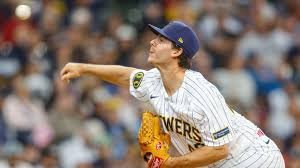
Logan Henderson: The Milwaukee Brewers’ Secret Weapon on the Mound
In the world of Major League Baseball, most managers love a pitcher who can induce a ground ball. It’s the safe play, the reliable way to get an out. However, Logan Henderson is proving that you don’t need to play by the traditional rules to achieve elite results. The Milwaukee Brewers’ right-hander is carving out a unique identity on the mound, and the numbers are nothing short of impressive.
A Different Approach to Pitching
If you’re looking for ground balls, you won’t find many with Henderson. With a ground-ball rate of just 17.8%—the third lowest among qualifying pitchers—Henderson is an outlier. He consistently allows fly balls, line drives, and pop-ups. While this might sound risky, it’s working perfectly for the Brewers.
Stepping in during a challenging period with injuries to key players like Brandon Woodruff and Quinn Priester, Henderson has been a beacon of stability. He boasts a stellar 3.50 ERA across four starts and a career ERA of 2.49, placing him among only seven pitchers in franchise history to maintain a sub-2.50 ERA in their first nine career starts.
Elite Efficiency: Strikeouts and Control
What makes Logan Henderson so dangerous isn’t raw power, but precision and deception. Despite an average fastball velocity of 93.2 mph, his ability to keep hitters off-balance is world-class. Here is a glimpse at his efficiency:
- n
- K-Rate: An impressive 32.4% strikeout rate this season.
- Walk Rate: A remarkably low 4.2%, showing elite command of the zone.
- K-BB Rate: His strikeout-minus-walk rate of 28.2% ranks him among the top three starting pitchers in the league.
To put his dominance in perspective, Henderson has racked up 56 strikeouts in his first nine Major League starts. In the history of the Milwaukee Brewers, only Freddy Peralta and Corbin Burnes have achieved more in the same span.
Decoding the Arsenal: The Movement That Fools Hitters
The secret to Henderson’s success lies in the movement of his pitches. He ranks in the top 20 among qualifying pitchers for either horizontal or vertical movement across his entire four-pitch repertoire:
| Pitch | Movement Characteristic | MLB Rank/Impact |
|---|---|---|
| Four-seamer | +2.5″ Vertical Drop | Tied for 17th |
| Cutter | +4.2″ Vertical Drop | 9th |
| Slider | +6.9″ Horizontal Break | Tied for 9th |
| Changeup | +5.1″ Horizontal Break | 3rd |
While he has increased his usage of the cutter in 2026, his primary weapons remain the four-seam fastball (44.2% usage) and the changeup (32.3% usage). The changeup, in particular, is a nightmare for batters, boasting a .193 expected wOBA.
The Fly-Ball Paradox: Why It Works
You might wonder why a high fly-ball rate isn’t leading to more home runs. The answer is soft contact. Henderson ranks in the 92nd percentile of MLB pitchers in hard-hit rate (28.9%).
Even though batters are hitting the ball in the air, they aren’t hitting it hard. Out of 37 batted balls, only 12 were hard-hit. This ability to induce weak contact effectively neutralizes the risk of his lofted delivery, making him one of the most intriguing young arms in the league.
As he continues to develop, Logan Henderson is proving that there is more than one way to dominate a lineup. For the Brewers, this unconventional approach is paying off in a big way.
For more in-depth baseball analysis and player stats, visit Baseball-Reference.