The Shifting Landscape of College Basketball in North Carolina
Sign up for The Quad, The Assembly’s Premium higher education newsletter. Arrives on Thursdays. Try it FREE for 6 weeks! Sign up for The Caucus, The Assembly’s Premium politics newsletter. Arrives twice weekly on Tuesdays and Fridays. Try it free for 6 weeks! Join 34,000+ readers who gain important insights into N.C. with our essential statewide newsletter, delivered to your inbox every weekday. Become part of our community of informed readers today. The Assembly NC – North Carolina’s digital magazine on place and power.
Coaching Turmoil and the New Era
Update: N.C. State announced Justin Gainey as its new men’s basketball coach. At the end of a week of unprecedented coaching turmoil in the Triangle, the shockwaves were still reverberating. At the Midwest Regional of the NCAA basketball tournament in Chicago, with few Atlantic Coast Conference schools in sight, three of the four coaches were considered potential candidates for the newly opened job at UNC-Chapel Hill. And the fourth was the one guy who would never, ever get it.
Alabama’s Nate Oats and Iowa State’s T.J. Otzelberger were both asked about the UNC vacancy. Michigan’s Dusty May was also a subject of hallway murmurs. Even Tennessee’s Rick Barnes, with his long-standing history with Dean Smith, received a joking inquiry. “Hey, I’m from North Carolina!” Barnes, a Hickory native, quipped, acknowledging his past. He did, however, highlight his assistant coach Justin Gainey, a former N.C. State player, for the Wolfpack’s opening after Will Wade’s departure to Louisiana State.
From budget discussions to new legislation, our reporters deliver exclusive insights in our twice-weekly Premium newsletter. Try it free for 6 weeks! Get scoops and insights on major decisions and key leaders at N.C.’s colleges and universities, rounded up by our veteran reporters every Thursday. Try it FREE for 6 weeks! Join thousands of North Carolinians in-the-know about their state. Sign up – the newsletter is free. Every Monday, Wednesday, and Friday.
Duke and the State’s Gravitational Pull
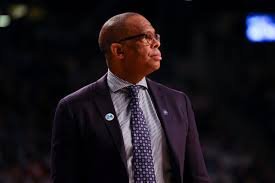
With Duke as the overall No. 1 seed in the men’s tournament, North Carolina continues to be a major force in college basketball. Last week’s events underscored just how much the game has changed. Wade left N.C. State abruptly, while Hubert Davis was released from his position at UNC. These departures occurred under different circumstances, reflecting the contrasting personalities and coaching styles of the two men.
Wade arrived and left Raleigh as a pragmatic coach, building a roster through the transfer portal. Davis, on the other hand, attempted to emulate Roy Williams, focusing on recruiting top-tier players. However, both are products of the modern college-sports system, where loyalty is often secondary to other factors.
The Impact of NIL and Changing Dynamics
This shift didn’t happen overnight. It’s the result of years of resistance from those who benefited from a flawed system. The impact is now being felt by everyone, including Rick Barnes, who found humor in the idea of him coaching at UNC. However, he also cautioned UNC, stating that past success doesn’t guarantee future results. “The obvious problem today is there’s some fan bases that still think they have an entitlement and they think it’s going to be the same way,” Barnes said. “The game has changed totally because of NIL.”
Despite the changes, it’s hard to argue that Davis wasn’t meeting the standards set by the Tar Heels. There’s value in upholding those standards, even if it means acknowledging a shift in the landscape. Davis reluctantly hired a general manager last season, outsourcing contract negotiations with recruits and transfers. He struggled to navigate the complexities of the modern game, insisting that UNC “is not a transactional program.” However, in today’s environment, everything has a price.
The Wade Saga and the Evolution of College Sports
Wade first gained notoriety during the FBI’s investigation into corruption in college basketball in 2019. A wiretap revealed a discussion about a “strong-ass offer” to a player, a practice that is now commonplace but was illegal at the time. Upon arriving at N.C. State, he joked that the game had finally caught up with his methods. However, his roster never gelled, and his demeanor frustrated fans. When LSU offered a lucrative deal, he quickly returned, demonstrating a pattern of prioritizing personal gain.
These changes – coaches being sold to the highest bidder and loyalty being abandoned – are symptoms of larger issues in college athletics. The transition from an extracurricular activity to a multi-billion dollar business has been poorly managed. For decades, a scholarship was considered fair compensation for athletes, coaches and administrators earned decent salaries, and the NCAA maintained significant control. However, the influx of television money disrupted this balance.
The NCAA fought against players receiving a share of the revenue, but the dam began to crack with the legalization of NIL in California in 2019. This allowed players to profit from their name, image, and likeness through endorsements, appearances, and other opportunities. Other states followed suit, and the Supreme Court’s 2021 decision in Alston v. NCAA further weakened the NCAA’s control.
Ultimately, the NCAA chose to fold rather than fight a lawsuit challenging its amateurism rules. This opened the door to direct payments to athletes and revenue sharing. While the NCAA could have acted more proactively, the legal landscape forced its hand. Athletes now have the freedom to transfer schools more easily and are essentially free agents.
Amid all this upheaval, college sports are arguably no more broken than they ever were. Players are no longer unpaid laborers, and the dysfunction is out in the open. Fans may complain, but they continue to watch, and television ratings remain high. It’s jarring to see UNC conducting a coaching search outside its traditional circles and witnessing the blatant self-interest of figures like Wade. When things change in college basketball, North Carolina often feels it first and most deeply.
Luke DeCock, a three-time winner of the North Carolina Sportswriter of the Year, was a sports columnist for the Raleigh News & Observer for 20 years. Some of Western North Carolina’s “rockhounds” are mining for rubies and emeralds. Others dig for something deeper.
In recent years, companies nationwide have fought to keep opera profitable and relevant. In Raleigh, NC Opera just put on the best-selling show in company history. Lily King’s “Heart the Lover” commemorates three men who bonded as students in Chapel Hill.
Every weekday morning, you’ll get: 🗞 The news you need 📝 Stories from across the state 📚 Delivered directly to your inbox Sign up today — it’s free! Don’t just read about North Carolina—help to create more stories about the place we call home. By joining The Assembly Network as a member, you help to sustain reporting and storytelling that captures North Carolina’s triumphs, challenges, and complexities.
Enter the code sent to your email
Email address
Enter your password
Sign in by entering the code we sent to , or clicking the magic link in the email. By signing up, you agree to our Terms and Conditions. This site is protected by reCAPTCHA and the Google Privacy Policy and Terms of Service apply. You have no free articles remaining. Create an account with The Assembly and get 2 additional free articles every month.