Julius Erving and the Revolutionary Spirit of the ABA
INDIANAPOLIS – For many nights, after electrifying home games at the State Fair Coliseum, the Indiana Pacers would gather at Neto’s, a bar owned by their beloved star, Bob Netolicky. Neto’s wasn’t just a post-game hangout; it was a melting pot where Pacers players from the American Basketball Association (ABA) mingled with fans, local celebrities, and anyone seeking camaraderie over a drink. Inside those walls, color lines blurred, professional status didn’t matter, and political divides dissolved. A shared love for the Pacers united everyone.
“The Pacers united a community,” Netolicky reflects in “Soul Power,” Prime Video’s captivating four-part documentary series debuting Thursday. The series chronicles the Pacers dynasty and the broader impact of the ABA. Mark Montieth, a long-time Pacers writer, adds, “(The Pacers) were the only thing in town where Black people and white people both would go to and mix together.”
The ABA: A League Ahead of Its Time
“Soul Power” offers early access to a documentary that reveals how the ABA not only reshaped professional basketball on the court but also revolutionized player empowerment and American sports culture. Former players, historians, and journalists argue that the modern NBA owes its existence to the ABA’s pioneering spirit. As Dan Issel, a former Denver Nuggets player, puts it, “(The NBA) looks a whole lot like the way we used to play in the ABA.”
The ABA introduced innovations like the 3-point shot, the slam dunk contest, and a fast-paced offensive style. But its impact extended beyond the game itself. The league championed civil rights and fostered a genuine brotherhood among teams, known for fierce competition on the court followed by shared meals and late-night revelry.
The Pacers: A Model of Brotherhood
Among ABA teams, the Indiana Pacers exemplified this “brotherhood” more than any other. While other teams saw players jump ship to the NBA, the Pacers’ roster – featuring stars like Mel Daniels, Roger Brown, Bob Netolicky, Darnell Hillman, Billy Keller, and George McGinnis – remained remarkably loyal and united.
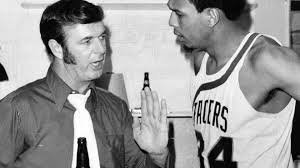
Larry Brown, who both played for and coached the Pacers, encapsulates this spirit: “I wish our world was like a Pacers locker room. It’s all about, can you play and are you a decent human being? Do you care about the people that sit next to you on both sides? That’s the only thing that matters.” He continues, “They (The Pacers) were so closely knit. When we would go to play them, you could just always sense that was a family. They developed an unbelievable bond.”
Beyond the Court: Style, Culture, and the Afro
The Pacers’ bond extended into the city, creating a unique spectacle of diversity at the Coliseum. But the ABA’s influence wasn’t limited to basketball and community. It was a league that embraced individuality and challenged norms. Spencer Haywood, a former Denver Rocket, recalls, “We had the flare collars, we had the bellbottoms, we had the platform shoes…we had the ‘fros. They couldn’t grow ‘fros in the NBA.”
The iconic Afro, particularly that of Darnell Hillman, became a symbol of the ABA’s cultural impact. Hillman, known as “Dr. Dunk” for his acrobatic moves, even won the first NBA slam dunk contest in 1977. But his hairstyle often sparked more conversation. As Hillman jokes, “6-foot-9 without the Afro…7-foot-3 with it!”
Interestingly, it was Hillman who taught Julius Erving, arguably the ABA’s biggest superstar, how to shape his own Afro. Erving recounts Hillman’s advice to ditch the traditional Afro picks and use an angel food cake cutter instead, resulting in a significantly larger and more impressive hairstyle.
The ABA’s acceptance of Afros and other culturally expressive attributes stood in stark contrast to the NBA, where such styles were banned.
The Pacers’ Reign and Lasting Legacy
Bob Costas, a longtime sportscaster and former ABA announcer, unequivocally states that the Pacers were the “flagship franchise of the ABA,” winning three of the league’s nine championships. The 1972 ABA Finals, where the Pacers defeated the Nets, are highlighted in “Soul Power,” showcasing the team’s dominance. Rick Barry, a player on the 1972 Nets, acknowledges that a Pacers team had they joined the NBA would have been a formidable competitor.
“Soul Power” concludes with a gathering of the 1972 Pacers, narrated by Common, a rap artist and actor whose father played in the ABA. Common reflects on the lasting impact of these ABA greats, stating, “The roots of what they accomplished still reach out to connect us today.”
Stream “Soul Power” beginning Feb. 12 on Prime Video.