Greenland Ice Sheet: Unveiling Hidden Convection Currents
Deep within the Greenland ice sheet, radar imagery has revealed peculiar, plume-like structures distorting the ancient layers of ice. After more than a decade of investigation, scientists believe they’ve finally cracked the code behind these formations, and the explanation is truly remarkable.
According to advanced modeling, these plumes strikingly resemble thermal convection – the same process that drives heat transfer in Earth’s mantle, responsible for volcanic activity and plate tectonics. “Finding that thermal convection can happen within an ice sheet goes slightly against our intuition and expectations,” explains glaciologist Robert Law of the University of Bergen in Norway. “Ice is at least a million times softer than the Earth’s mantle, though, so the physics just work out. It’s like an exciting freak of nature.”
Why This Matters: Greenland’s Role in Sea Level Rise
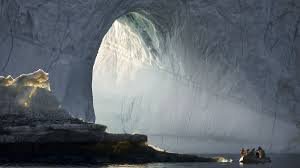
The Greenland ice sheet, covering 80% of the island, is a massive reservoir of frozen water and a key player in projected sea level rise. Understanding the internal dynamics of this ice sheet is crucial for accurately predicting its future behavior. This is why scientists employ ice-penetrating radar, which sends radio waves through the ice, reflecting off internal layers formed by accumulated and compacted snow over millennia.
These layers possess unique characteristics – subtle variations in acidity, dust content, and chemical composition – allowing researchers to map the ice sheet’s internal structure. In 2014, radar images revealed these enigmatic, upward-buckling structures in northern Greenland, a puzzle that has captivated researchers ever since.
From Mystery to Modeling: The Convection Hypothesis
Initial theories proposed explanations like freezing meltwater or migrating slippery zones. However, the possibility of thermal convection within the ice sheet hadn’t been thoroughly investigated. Law and his team turned to computer modeling to test this hypothesis.
They created a digital representation of a section of the Greenland ice sheet and asked: could convection form structures mirroring those observed in the radar images if the base of the ice was warmed? Utilizing a geodynamics modeling package typically used for Earth’s mantle simulations, they modeled a 2.5-kilometer (1.6-mile) thick ice slab, adjusting variables like snowfall rate, ice thickness, ice softness, and surface flow speed.
The results were astonishing. Under specific conditions, the model generated plume-like upwellings – rising columns of ice that folded the overlying layers into shapes remarkably similar to those seen in the radar data. These plumes only formed when the ice near the base was warmer and softer than previously assumed, suggesting the base of the Greenland ice sheet may be more pliable than scientists thought.
The Heat Source: Earth’s Internal Engine
The heat required to drive these convection currents aligns with the continuous heat flow emanating from Earth’s interior, generated by radioactive decay and residual heat from the planet’s formation. While this heat flux is minimal, over vast timescales and beneath a massive insulating layer of ice, it can accumulate enough to warm and soften the ice above.
“We typically think of ice as a solid material, so the discovery that parts of the Greenland ice sheet actually undergo thermal convection, resembling a boiling pot of pasta, is as wild as it is fascinating,” says climatologist Andreas Born of the University of Bergen.
What Does This Mean for the Future?
It’s important to note that this doesn’t mean the ice is turning to slush. It remains solid, albeit flowing over thousands of years. Nor does it automatically equate to accelerated melting. Further research is needed to understand the implications of convection for the ice sheet’s evolution and future stability.
“Greenland and its nature is truly special. The ice sheet there is over one thousand years old, and it’s the only ice sheet on Earth to have a culture and permanent population at its margins,” Law emphasizes. “The more we learn about the hidden processes inside the ice, the better prepared we’ll be for the changes coming to coastlines around the world.”
This groundbreaking research was published in The Cryosphere.
Related: World’s Deepest Gas Hydrate Discovered Teeming With Life Off Greenland