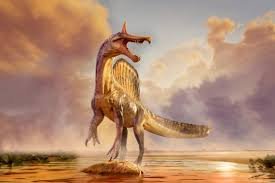
Spinosaurus mirabilis: A New Dinosaur Species Unearthed in Niger
In a groundbreaking discovery, scientists have unearthed fossils of a new species of Spinosaurus in the Sahara Desert of Niger. This remarkable find sheds new light on one of the largest meat-eating dinosaurs to ever roam the Earth, known for its distinctive blade-shaped head crest and specialized teeth for catching slippery fish.
A Semi-Aquatic Predator
Spinosaurus mirabilis prowled a forested inland environment approximately 95 million years ago during the Cretaceous Period. Unlike its more famous cousin, Tyrannosaurus rex, this dinosaur was uniquely adapted for a semi-aquatic lifestyle, striding into rivers to ambush sizable fish much like a modern-day wading bird – a “hell heron,” as one researcher aptly put it. At an impressive 40 feet long and weighing between 5-7 tons, it was a formidable predator.
Distinctive Features of Spinosaurus mirabilis
This new species boasts several striking features. Its bony cranial crest, reaching approximately 20 inches in height, resembles a curved sword, or scimitar. Adding to its unique profile was a large, sail-like structure on its back and an elongated, crocodile-like snout. Researchers have named the species mirabilis, meaning “astonishing,” a fitting tribute to its remarkable crest.
Spinosaurus joins the ranks of other colossal meat-eating dinosaurs like Tyrannosaurus, Giganotosaurus, and Carcharodontosaurus. While Spinosaurus aegyptiacus, discovered in 1915, was the first known species, Spinosaurus mirabilis presents key differences.
Key Differences Between Spinosaurus mirabilis and Spinosaurus aegyptiacus:
- Crest Size: Spinosaurus mirabilis possesses a significantly larger crest.
- Snout Length: Its snout is more elongated.
- Tooth Spacing: Teeth are more widely spaced.
- Hind Limb Length: Longer hind limbs.
Adaptations for a Piscivorous Diet
The researchers believe the crest served primarily for display, likely used in attracting mates or establishing territorial dominance. Its solid bone structure, though robust, appears too fragile for use as a weapon. The crest was likely covered in keratin, similar to a bull’s horns, and potentially vividly colored.
Spinosaurus mirabilis’s adaptations for hunting fish are exceptional. Its retracted nostrils allowed it to submerge most of its snout while breathing, and its interlocking teeth formed a “fish trap,” preventing slippery prey from escaping. As paleontologist Daniel Vidal explains, “Spinosaurus mirabilis has some of the most extreme piscivorous adaptations of any dinosaur, so we know it was better at preying upon fish than it would have been at preying upon other dinosaurs.”
Inland Predator, Not Fully Aquatic
Previous theories suggested Spinosaurus was fully aquatic, thriving in open water. However, the discovery of Spinosaurus mirabilis fossils far inland – 300-600 miles from the nearest ocean shoreline – challenges this hypothesis. The anatomical features of this new species point to a shallow-water predator, rather than a deep-sea swimmer.
The Discovery Site
The fossils were discovered in Jenguebi, a remote location in the Sahara Desert. The expedition involved a challenging three-day off-road journey from Agadez, Niger, often navigating difficult sandy terrain. The effort proved worthwhile, yielding parts of three Spinosaurus mirabilis skulls and other significant fossils.
As paleontologist Paul Sereno aptly stated, “It’s a dino-happening!” Spinosaurus is finally taking its rightful place in the spotlight, overshadowing even the mighty T. rex in the public imagination.