## Fajr and the Shifting Sands of Ramadan: How Daylight Saving Time Impacts American Muslims
As Ramadan approaches, millions of American Muslims are preparing for a month of fasting, prayer, and spiritual reflection. This year, however, a unique challenge looms: Daylight Saving Time. The shift in clocks on March 8th will disrupt the carefully constructed routines of those observing Ramadan, adding an extra layer of complexity to an already demanding practice.

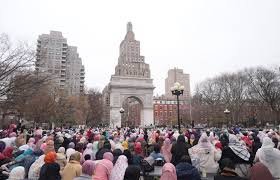
Eid al-Fitr prayer at Washington Square Park in New York on March 30, 2025. (TIME)
### The Lunar Calendar and the Gregorian Shift
The Islamic calendar is lunar, meaning it’s based on the cycles of the moon, differing from the Gregorian calendar—the solar calendar used globally. Imam Farhan Siddiqi of Dar Al-Hijrah Islamic Center explains, “The [lunar calendar] translates to about 10 days less than the solar calendar. Because it’s 10 days shorter, the months are going to shift 10 days every single year.” This means Ramadan cycles through all seasons over roughly 33 years.
This year, Ramadan begins around February 17th and extends through mid-March. When Daylight Saving Time kicks in, the daily rhythm of fasting shifts by an hour. For example, in New York City, *iftar* (the evening meal breaking the fast) might typically occur around 5:45 p.m. on March 7th, shifting to 6:55 p.m. after the time change on March 8th. The fast itself doesn’t lengthen, but all associated activities – dinner, pre-dawn meals (*suhoor*), prayers, and sleep – are pushed back an hour.
### The Impact Across the US and Canada
The disruption primarily affects those in the continental U.S. (excluding Arizona and Hawaii) and most of Canada (excluding parts of Saskatchewan, Yukon, and some regions of British Columbia and Quebec). Muslims in regions without Daylight Saving Time, like much of the Middle East and Asia, won’t experience this mid-Ramadan shift.
### Adapting to the Change
While the change may seem minor, it requires significant adjustment. Lubna Turaani, a 26-year-old nurse and student in Virginia, has been strategizing for weeks, canceling her gym membership and meticulously planning meals. Aseel Hasan, a pregnant mother in Cincinnati, is determined to fast despite the challenges, focusing on hydration and energy levels.
“I haven’t had to plan for cooking and cleaning as much as I’ve had to plan for my work and study schedule,” Turaani says. She’s even planning to take a date and soup to work to break her fast early.
Imam Abdul-Malik Merchant of Hearts Together Foundation offers a perspective of resilience: “Maybe you’ve been training all year for a marathon and now there’s hills. Well, that’s a new variable and tests a new type of stamina that you didn’t know you needed. The time change is a new variable that’s going to be a new opportunity to deepen our resolve and our devotion.”
### Showing Support
Understanding this shift is crucial for non-Muslims with family, coworkers, or friends observing Ramadan. A colleague who seemed energetic in early March might appear more fatigued after the time change, not due to a longer fast, but due to schedule disruption. Flexibility and understanding are key.
As Turaani suggests, the experience can foster thoughtfulness and appreciation. “It’s nice to experience every time I break my fast because it’s a good reminder about anything in life,” she says, drawing a parallel to perseverance in hardship.
Ultimately, American Muslims are approaching this unique Ramadan with a blend of practical planning and spiritual resolve, viewing the challenge as an opportunity for growth and deeper connection. As Imam Siddiqi puts it, “We treat Ramadan as a springboard… It’s actually a catalyst that gives us that spiritual energy to continue the rest of the year.”
[Learn more about Ramadan](https://www.islamicreliefusa.org/what-is-ramadan/).
© 2026 TIME USA, LLC. All Rights Reserved.