
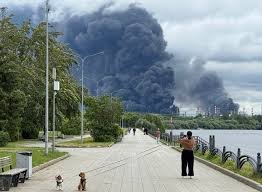
The Irony of Energy: Fuel Lines in the Heart of Moscow
In a shocking turn of events for one of the world’s leading energy superpowers, the streets of Moscow are witnessing a sight once thought impossible: long queues of frustrated drivers waiting for gasoline. For many citizens, the daily routine has shifted from commuting to searching for fuel, as an acute national shortage grips the Russian capital.
For years, the Kremlin worked tirelessly to insulate the Russian public from the hardships of the conflict in Ukraine. However, as the war enters its fifth year, the facade is cracking. The reality of what Vladimir Putin continues to label a “special military operation” is now hitting home, manifesting at the gas pump.
Ukraine’s Strategic Shift: Bleeding the War Economy
The current crisis is not accidental. It is the direct result of an unprecedented and sophisticated Ukrainian drone campaign. By targeting critical infrastructure deep within Russian territory, Kyiv is shifting the cost of war from the battlefield to the Russian economy.
Recent reports indicate a massive scale of operations, including a single night where Russia claimed to intercept 660 drones across 12 different regions. The targets are surgical and strategic:
- n
- Oil Refineries: Disrupting the production of refined fuel.
- Oil Terminals: Choking the distribution and export of energy resources.
- Weapons Plants: Hindering the manufacturing of military hardware.
- Naval Vessels: Weakening the Russian Black Sea fleet.
This strategy aims to create a ripple effect, raising the political and economic price of the war for the Kremlin and its supporters.
Putin’s Admission: An Emergency Response
For a leader who typically dismisses setbacks, Vladimir Putin has been forced to acknowledge the severity of the situation. During a recent emergency meeting, the Russian President admitted that national gasoline reserves have dropped to “uncomfortable levels.”
Putin warned senior officials that the pressure on businesses and drivers is persisting, confirming that queues at gas stations are a reality he can no longer ignore. Furthermore, the Kremlin is now considering a complete ban on diesel exports—a move that signals desperation in maintaining domestic stability.
The Global Perspective: Is the Tide Turning?
Western allies are viewing these developments as a sign of Russian exhaustion. At the G7 summit, European Commission President Ursula von der Leyen noted that “the tide is turning for Ukraine,” suggesting that 2026 will look very different from previous years due to Russia’s visible fatigue.
According to analysis by the Council on Foreign Relations, the scaling up of these drone operations has directly impacted the battlefield, contributing to Ukraine retaking significant territories by choking military fuel supplies.
Even the rhetoric from US President Donald Trump has shown a shift, describing Ukrainian President Volodymyr Zelensky as “courageous” and urging Russia to “make a deal,” signaling a potential change in the international diplomatic landscape.
Will Economic Pressure Force a Capitulation?
While the fuel crisis is a significant blow, experts warn against assuming it will lead to an immediate surrender. Vladimir Putin has spent decades cultivating an image of an uncompromising leader. For him, any retreat or compromise could be perceived as weakness, potentially triggering internal political instability.
With immense casualties and territorial claims still unresolved, the “hawks” within Putin’s inner circle continue to push for total control of the Donbas region. Burning refineries may cause hardship, but they have not yet forced a white flag from the Kremlin.
As the economic pressure mounts, the world watches to see if the domestic strain in Russia will finally outweigh the geopolitical ambitions of Vladimir Putin.



