
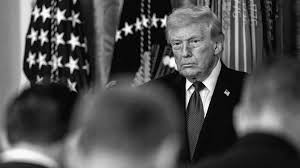
US-Iran Conflict: A Challenge to Presidential Authority
Recent actions by the U.S. and Israel against Iran have ignited a critical debate regarding presidential authority and the limits of military action. The current situation demands a serious examination of the War Powers Resolution and Congress’s ability to oversee and control the use of force. This isn’t simply a legal argument; it’s a fundamental question about the balance of power in a constitutional republic.
Trump’s Unilateral Action and the Erosion of Checks and Balances
Donald Trump initiated military hostilities with Iran – a country with a combined population roughly equivalent to Iraq and Afghanistan – without a clear justification to the American people or the approval of their elected representatives. Dubbed “Operation Epic Fury,” this action represents a culmination of decades-long expansion of presidential power in national security matters, now taken to an extreme. While critics rightly point to potential legal violations under both U.S. and international law, the immediate concern is regaining control over a president seemingly acting as an unchecked authority.
The War Powers Resolution: A History of Limitations
Adopted in 1973 amidst the waning days of the Vietnam War, the War Powers Resolution aimed to limit the President’s ability to commit U.S. forces to armed conflict without Congressional consent. The resolution stipulates that the President can only introduce U.S. Armed Forces into hostilities without a declaration of war, specific statutory authorization, or a national emergency created by an attack on the U.S.
However, the resolution has proven largely ineffective. Presidents have consistently circumvented its restrictions by invoking “national emergencies” or relying on existing treaty obligations. Lyndon B. Johnson’s escalation in Vietnam, justified by the Gulf of Tonkin incident and treaty commitments, serves as a stark example. Congress, regretting its open-ended authorization in the Tonkin Gulf Resolution, attempted to correct course with the War Powers Resolution, but its impact has been limited.
The Resolution’s Flaws: Too Weak and Too Strong
The War Powers Resolution suffers from inherent contradictions. It requires presidential “consultation” with Congress, but only “if possible.” It also sets a 60-day limit on military action unless Congress declares war or extends the deadline. This time limit, while intended to force Congressional action, can be strategically exploited by adversaries, incentivizing them to delay negotiations or escalate violence in hopes of undermining Congressional resolve.
Lessons from the First Gulf War
During the lead-up to the 1991 Gulf War, a group of Republican senators considered invoking the War Powers Resolution to challenge President George H.W. Bush’s authority. However, concerns about a protracted political battle and the potential disruption of military operations led them to reconsider. Bush, determined to liberate Kuwait, signaled his willingness to proceed even if it meant facing impeachment. Ultimately, he secured resolutions of support from Congress before launching combat operations.
The Current Situation and Congress’s Options
Today, Trump faces a different political landscape. With the GOP controlling both houses of Congress and enjoying strong party loyalty, the threat of impeachment is less immediate. However, Congress still possesses the power to demand hearings, seek explanations, and utilize the War Powers Resolution as leverage. Invoking the resolution, even if largely symbolic, could force a much-needed debate and compel the administration to justify its actions.
The current crisis underscores a broader issue: the erosion of trust, norms, and basic decency in American democracy. A functioning system relies not solely on legal constraints but also on a shared commitment to deliberation, transparency, and accountability. Operation Epic Fury should serve as a catalyst for a serious reevaluation of presidential war powers and a renewed effort to restore a more balanced and constitutional approach to the use of military force.
Further Reading: The Atlantic: US-Iran Conflict and War Powers



