
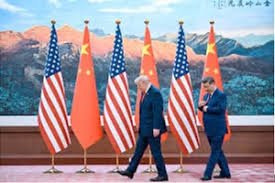
The Trump-Xi Summit: A New Era of Global Power Dynamics
The May 2026 summit between Donald Trump and Xi Jinping did more than just reopen diplomatic channels; it exposed a stark and uncomfortable reality for the West. While Washington and Beijing negotiate the future of global trade and investment through newly created bilateral councils, Europe finds itself in a precarious position—watching from the sidelines as decisions that shape its own industrial future are made elsewhere.
Whether the United States and China are locked in a trade war or shaking hands in a tactical truce, one thing is clear: the US-China axis is currently defining the global strategic agenda. For the European Union, the risk is twofold: it can be weakened by their conflict or marginalized by their agreement.
China’s Strategic Ascent: More Than Just Economic Growth
The recent summit served as a victory lap for Beijing, showcasing a nation that has successfully closed the gap with the United States across three critical dimensions:
- n
- Economic Dominance: Decades of rapid, double-digit growth have transformed China into a global financial titan.
- Technological Leadership: Since 2010, China has led the world in patent filings. According to a report by the Australian Strategic Policy Institute (ASPI), China dominates 69 out of 74 critical emerging technologies.
- Geopolitical Leverage: Through the Belt and Road Initiative, the expansion of the BRICS bloc, and a near-monopoly on the refining of critical raw materials, Beijing has ensured it can negotiate from a position of strength.
This accumulation of power was evident in early 2025. When the US attempted to impose exceptional tariffs, China didn’t just absorb the blow—it responded with enough leverage to force a negotiation between equals.
Truce or Transformation? The US-China Relationship
Washington entered the summit seeking tangible wins: trade stabilization, increased Chinese purchases, and minimal coordination on Iran. Beijing, conversely, sought a relationship of “strategic parity,” where trade is stable but the “red line” of Taiwan remains non-negotiable.
The creation of two bilateral councils for trade and investment suggests two possible scenarios:
- The Tactical Truce: A temporary “oxygen bubble” where tensions are managed to soothe markets, but the underlying rivalry—especially in AI, quantum computing, and semiconductors—remains unchanged.
- Controlled Coexistence: A shift toward “constructive strategic stability,” where both superpowers define spheres of influence and zones of agreement to avoid total conflict.
The European Trap: Between Diversion and Marginalization
For the European Union, both scenarios are dangerous. If a trade war resumes, Europe suffers from trade diversion, becoming a dumping ground for Chinese exports that can no longer enter the US market.
However, if the US and China reach a managed coexistence, the danger is marginalization. Technical standards, strategic product lists, and global regulatory frameworks could be decided in a bilateral dialogue, leaving the EU as a secondary player following rules it didn’t help write.
The Path Forward: Strategic Autonomy for Europe
The lesson of the Trump-Xi summit is clear: economic weight does not automatically translate into strategic power. To avoid becoming a geopolitical bystander, the EU must abandon two dangerous illusions:
- The Illusion of Bilateralism: Individual member states (like France or the UK) cannot negotiate with China as global powers; Beijing treats them as regional partners, reserving “strategic” language only for Washington.
- The Illusion of Market Size: Having a large internal market is an advantage, but it is eroding. Market depth is useless without a unified political will.
To survive and thrive, Europe must coordinate its trade, industrial, and security policies. This means reducing critical dependencies not through slogans, but through concrete investments in refining capacities, mining partnerships, and strategic public procurement, aligned with the European Commission’s goals for strategic autonomy.
Final Thought: A disunited Europe is condemned to hold its breath while Washington and Beijing speak. The only way to get a seat at the table is to speak with one voice.



