
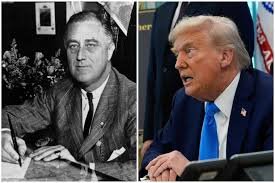
The Legacy of FDR: Can New Deal Values Survive in the Modern Era?
In an era of deep political polarization and shifting executive powers, a critical question emerges: Can the values of the New Deal survive today? For many, the New Deal isn’t just a chapter in a history book; it is a blueprint for a government that serves the many, not the few. According to James Roosevelt Jr. (grandson of FDR) and Henry Scott Wallace (grandson of FDR’s vice president), the struggle between populist empowerment and elite control is more relevant now than ever.
FDR vs. Modern Governance: A Study in Contrasts
President Franklin D. Roosevelt (FDR) inherited a federal government that was largely stagnant and transformed it into a powerful engine for social good. His approach was rooted in legislative collaboration and a commitment to the “forgotten man.”
Contrast this with the contemporary trend of governance by executive fiat. Where FDR worked with Congress to reimagine the role of government, recent trends have seen the dismantling of pro-people programs in favor of policies that prioritize the wealthiest 1%. From the prioritization of massive military budgets over essential services like Social Security and Medicaid, the shift is palpable.
Core Values Under Assault
The New Deal was built on two fundamental pillars that remain under threat today:
- n
- Respect for the Constitution: The U.S. Constitution was designed to prevent all-powerful rulers. FDR respected the legislative process, whereas modern trends often lean toward an all-powerful executive branch.
- Welfare for All: FDR’s 1932 landslide victory was a response to the Great Depression. He implemented an “alphabet soup” of programs designed to rescue family farms, protect workers, and curb the excesses of rapacious banks.
The Spark That Started It All: The Tragedy of 1911
To understand the heart of FDR’s vision, one must look back to March 25, 1911. A young social worker named Frances Perkins witnessed the horror of the Triangle Shirtwaist Factory fire in New York. 146 workers, mostly immigrant women and children, perished because factory owners had locked the exits to prevent breaks.
This tragedy became the catalyst for the New Deal. Perkins later became the first female cabinet member in U.S. history, serving as FDR’s Labor Secretary. Her influence led to landmark protections that we often take for granted today, including:
- n
- The outlawing of child labor.
- The establishment of a minimum wage and maximum work hours (creating the concept of the weekend).
- The creation of unemployment insurance.
- The crowning achievement: Social Security.
Global Echoes: From the US to Hungary
The fight for a government that works for ordinary people is not limited to American shores. The authors point to Hungary as a beacon of hope, where a long-standing autocracy was recently unseated by a popular vote. This suggests that the craving for reasonable security against the “hazards and vicissitudes of life” is a universal human drive.
Conclusion: A Renewed Vision for the 99%
The American people are not seeking preferential treatment for the powerful; they are seeking the same basic economic security that FDR championed nearly a century ago. While the New Deal is under threat, there is a growing movement of citizens reclaiming their government.
The vision of Franklin D. Roosevelt—that the test of progress is not how much we add to the abundance of those who have much, but whether we provide enough for those who have too little—remains a timeless North Star for a fair and just society. You can learn more about this era at the FDR Presidential Library and Museum.



