
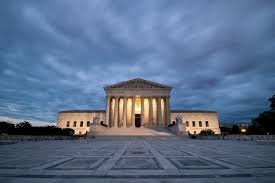
Supreme Court of the United States: A New Look at Birthright Citizenship
The Supreme Court’s October 2025 term is already shaping up to be pivotal, with cases like Trump v. Barbara drawing significant attention. This case centers on the interpretation of the 14th Amendment’s citizenship clause and raises fundamental questions about birthright citizenship in the United States. A key point of contention revolves around whether the exceptions to birthright citizenship are fixed in time or can evolve with changing circumstances. This debate echoes the Court’s recent approach to the Second Amendment, highlighting a broader discussion about originalism and its application in the 21st century.
The Second Amendment Parallel: A Constitution Not ‘Trapped in Amber’
The Court has consistently affirmed that the Constitution is not a static document. As articulated in cases like District of Columbia v. Heller (2008) and New York State Rifle & Pistol Association v. Bruen (2022), originalism doesn’t mean adhering to an unchanging interpretation. Instead, it requires applying the original meaning of constitutional provisions to modern realities. Bruen established a two-stage analysis for Second Amendment claims: first, determining if the conduct falls within the plain text of the amendment, and second, assessing whether any regulation is consistent with the nation’s historical tradition of firearm regulation.
Consider the example of modern semiautomatic handguns. These weapons didn’t exist at the Founding, yet the Court has ruled they are protected under the Second Amendment. The key is applying the contemporary definition of “Arms” to determine coverage. Similarly, when evaluating regulations, the Court examines the underlying principles of historical laws and applies them to present-day circumstances. The principle isn’t simply replicating past laws, but understanding the rationale behind them and whether that rationale still holds true.
The ‘Closed Set’ Argument in Trump v. Barbara
During oral arguments in Trump v. Barbara, counsel for the challengers, Cecillia Wang, repeatedly argued that the exceptions to birthright citizenship – for children of ambassadors, tribal Indians, and invading armies – constitute a “closed set,” established in 1868 with the 14th Amendment. Several justices, however, expressed skepticism. Justice Amy Coney Barrett directly questioned this assertion, asking, “But why is it closed? … The language doesn’t say it’s closed.” Justice Brett Kavanaugh even drew a direct parallel to the Court’s Second Amendment jurisprudence, challenging the rigidity of this view.
This resistance to a “closed set” interpretation is significant. The citizenship clause states that “all persons born … in the United States, and subject to the jurisdiction thereof, are citizens of the United States.” Applying originalist principles, the Court should determine the original understanding of “subject to the jurisdiction” in 1868, the exceptions that were understood to exist at that time, and then apply that understanding to the specific cases before it – namely, the children of foreigners lawfully visiting the country and those unlawfully present.
Implications for Tribal Sovereignty and Unlawful Presence
The “closed set” argument has potentially far-reaching consequences. If tribal Indians were excluded from automatic birthright citizenship in 1868, and that exclusion remains absolute, it could lead to the surprising conclusion that individuals born on tribal lands today are also not automatic citizens. This stems from the argument that tribal reservations were then treated as effectively foreign soil. As Chief Justice Roberts noted in a dissent, this could impact citizenship status in areas like Tulsa, Oklahoma, due to the McGirt v. Oklahoma ruling recognizing tribal land rights.
Even more significant are the implications for the children of individuals unlawfully present in the country. The government argues these children are analogous to the children of temporary foreign visitors, with an even weaker claim to citizenship. However, Ms. Wang’s insistence on a “closed set” would preclude considering any new exceptions based on modern circumstances. The Court, following its Second Amendment precedent, should determine whether the children of those unlawfully present are analogous to those historically excluded from citizenship and whether the rationale for that exclusion still applies today.
A ‘New World’ with the Same Constitution
Chief Justice Roberts aptly summarized the situation during the arguments, stating, “Well, it’s a new world. It’s the same Constitution.” The Court’s jurisprudence, particularly in the Second Amendment context, demonstrates a commitment to applying enduring constitutional principles to evolving realities. Rejecting this approach in Trump v. Barbara would be a departure from established precedent and a distortion of originalist principles. The Court’s decision will undoubtedly shape the future of birthright citizenship in the United States.
Disclosure: Pete Patterson represents the Senator Eric Schmitt and Representative Chip Roy in an amicus brief filed in support of Petitioners in Trump v. Barbara.
Source: SCOTUSblog



